
Easter in Europe is far from the conventional bunny-and-egg story. Across the continent, ancient rituals and modern twists converge into celebrations that dazzle the senses and stir the soul.
Each destination offers a window into a rich tapestry of local lore and cultural pride, from fiery processions and explosive traditions to playful customs and eerie marches.
These little-known Easter destinations remind us that renewal can be celebrated in wildly different and utterly mesmerizing ways.
Step off the beaten path and explore a world where traditions are as vibrant as unexpected.
In one village, elaborate torches light ancient processions; in another, secret rockets transform an island into a battleground of light and sound.
Meanwhile, time-honored customs like egg decorating, whimsical door-to-door witching, and even a Dance of Death weave together beliefs of fertility, rebirth, and the eternal cycle of life.
Join us on this journey through seven extraordinary European locales, where every ritual tells a story and every celebration is a heartfelt tribute to life’s fleeting beauty!
1. The “Fracchie” Procession: San Marco In Lamis, Apulia, Italy
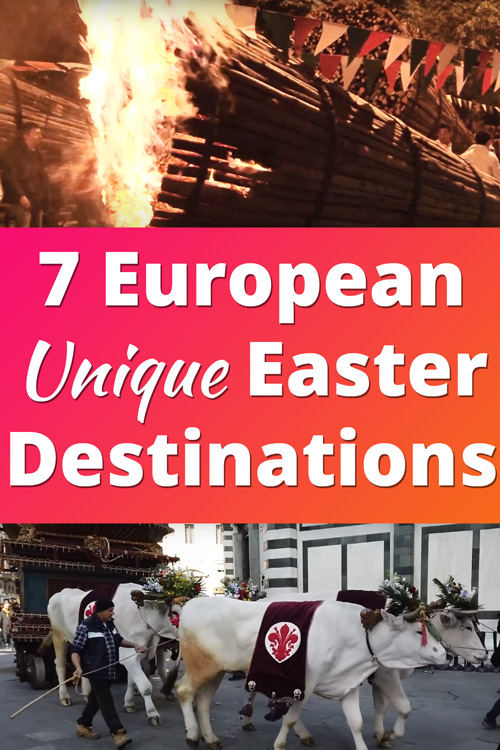
Tucked away in the Capitanata region of Apulia, the charming town of San Marco in Lamis boasts one of the most captivating and unique Easter traditions in Europe: the “fracchie” procession. This Good Friday ritual, organized by the Confraternity of the Seven Sorrows, illuminates the streets with the fiery glow of colossal wooden torches mounted on iron wheels.
These “fracchie,” some towering over six meters in height and weighing up to 100 quintals, are painstakingly constructed by skilled craftsmen and carried by devoted “fracchisti.” The spectacle accompanies the statues of the Madonna Addolorata (Our Lady of Sorrows) and the Christ of the Dead as they make their solemn journey through the town, creating an awe-inspiring tableau of light and devotion.

This video will be loaded from YouTube.com, a third party. If you click "Play", you accept their terms of service, and their use of cookies.
The tradition of the fracchie dates back centuries, with its origins linked to the practical need for lighting the path of the Madonna’s procession in an era before modern streetlights. Initially small handheld torches, these fiery beacons grew in size and grandeur over time, becoming a symbolic tribute to the Virgin Mary’s sorrowful search for her son.
By the mid-20th century, the fracchie had evolved into a competitive art form, as local groups vied to construct the largest and most spectacular torches. Despite their functional origins, the fracchie have come to represent both a communal act of devotion and an extraordinary feat of craftsmanship.
The procession itself is a deeply moving liturgical event, commencing on the evening of Good Friday and stretching late into the night. Participants, dressed in mourning attire, solemnly accompany the Madonna’s statue, while the fiery torches blaze brightly, illuminating her path.
The dramatic interplay of light, fire, and faith draws tens of thousands of visitors each year, eager to witness one of the world’s most unique fire rituals. It has even been recognized as a candidate for UNESCO Intangible Cultural Heritage, a testament to its profound cultural and historical significance.
San Marco in Lamis offers more than just the fracchie on Good Friday. On Holy Saturday, the streets transform into a stage for the Sacred Representation of Calvary, a reenactment of Christ’s Passion featuring local residents in traditional roles.
Finally, Easter Sunday brings a jubilant procession celebrating the Madonna adorned in her finest festive attire. Together, these events weave a rich tapestry of faith, artistry, and community that makes this Apulian town a must-visit destination for those seeking extraordinary traditions off the beaten path.
2. Midnight Mass and Egg Fights: Sofia, Bulgaria
Sofia, the vibrant capital of Bulgaria, offers a unique and unforgettable experience for celebrating Orthodox Easter. At the heart of the city lies the majestic Aleksander Nevski Cathedral, its iconic golden dome serving as a beacon for thousands of worshippers.
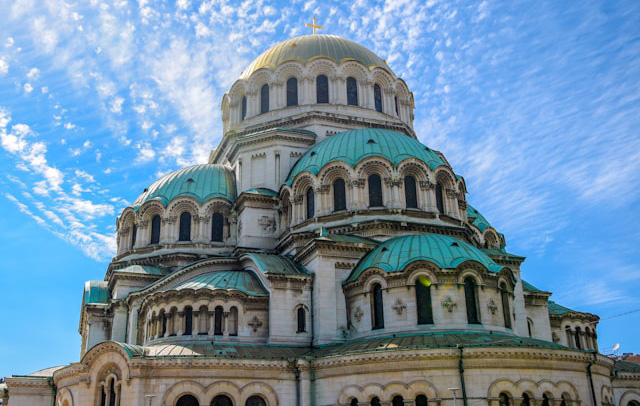
(Photo by Ivan Nedelchev on Unsplash)
Midnight Mass, an event of profound spiritual significance, marks the beginning of Easter Sunday. As the clock strikes 11 p.m. on Easter night, elegantly dressed faithful gather within the cathedral’s incense-filled interior, uniting their prayers in anticipation of the resurrection. This powerful communal ritual reflects centuries of Orthodox tradition and fills the air with reverence and solemnity.
The Easter celebrations in Sofia extend beyond the midnight liturgy, seamlessly blending spirituality with joyful family customs. The morning after the mass sees the arrival of a beloved Balkan tradition: the egg fight.
Armed with vibrantly colored hard-boiled eggs, participants, family members, friends, and churchgoers alike, engage in lively competitions to determine whose egg has the toughest shell. This spirited activity is more than just a test of strength and strategy; it symbolizes the resilience and prosperity hoped for in the year ahead. For the winner, cracking their opponent’s egg ensures a year filled with health and happiness.
This blend of solemn worship and lighthearted competition offers a window into the warmth and connectedness of Bulgarian culture. The midnight mass envelops attendees in a sacred atmosphere of devotion and hope, while the egg fights foster a sense of community and celebration. Both events exemplify the harmonious balance of faith and festivity that defines Easter in Sofia.
Sofia’s Easter celebrations promise a truly enriching experience. It’s a destination where centuries-old rituals come to life, inviting visitors to partake in a journey of faith, family, and festive fun unlike any other.
3. Explosion of the Cart, Florence, Italy
In Florence, the “Scoppio del Carro,” or Explosion of the Cart is a centuries-old ritual that begins with the lighting of the “sacred flame” in the 11th-century Church of Santi Apostoli.
The flame is then carried in a slow, ceremonial procession to the grand Cathedral of Santa Maria del Fiore (the Duomo). The procession is a spectacle in itself, featuring locals dressed in historical costumes, garlanded oxen adorned with fresh spring flowers, and a towering multi-tiered cart filled with fireworks.
The culmination of the event is nothing short of spectacular. The sacred flame is used to ignite the fuse of a mechanical dove, symbolizing the Holy Spirit. This dove is launched from inside the Duomo, and as it soars, it sparks the intricate firework display loaded onto the cart.

This video will be loaded from YouTube.com, a third party. If you click "Play", you accept their terms of service, and their use of cookies.
The resulting explosions and bursts of light create a symphony of sound and color, captivating all who gather to witness the scene. The Scoppio del Carro combines elements of tradition, faith, and festive celebration, offering a sensory experience like no other.
The origins of this unique ritual are steeped in history and legend. It is believed to have roots in the First Crusade, when a Florentine nobleman returned from Jerusalem with holy relics. Over time, the sacred flame became central to this ritual, symbolizing the resurrection of Christ and the renewal of faith.
Today, the Explosion of the Cart is held every Easter Sunday, drawing crowds who rise early to secure their spots for the fiery spectacle.
Whether you’re drawn to the historical roots, the dramatic pageantry, or the sheer joy of the event, the Scoppio del Carro is a must-see tradition that embodies the spirit and grandeur of Easter in Florence.
It’s a brilliant convergence of devotion, community, and celebration, cementing Florence’s reputation as a city where history comes alive in dazzling form.
4. Rocket War, Chios, Greece
Every Easter, the skies above the town of Vrontados on the Greek island of Chios come alive with a fiery spectacle known as “Rouketopolemos,” or the Rocket War.
This dramatic tradition takes place at midnight on Orthodox Easter Sunday, as two rival church congregations, Saint Mark’s and Panagia Ereithiani, engage in a mock battle, launching tens of thousands of homemade rockets toward each other’s belfries.
The goal is to score direct hits on the bell towers, a feat that is eagerly counted the next day, though both sides typically claim victory. The resulting “draw” ensures the rivalry continues, keeping this vibrant custom alive year after year.

This video will be loaded from YouTube.com, a third party. If you click "Play", you accept their terms of service, and their use of cookies.
The origins of Rouketopolemos are shrouded in legend, with local folklore tracing its roots back to the Ottoman period. It is said that real cannons were once used for the Easter celebrations, but when Ottoman authorities banned them in 1889, the townsfolk turned to homemade rockets instead.
Over time, this adaptation evolved into a dazzling display of both communal pride and pyrotechnic artistry. The rival churches, situated on hilltops about 400 meters apart, board up their buildings with metal sheets to minimize damage, as sparks light up the night in a breathtaking show.
The rockets themselves are meticulously crafted by the locals, creating an electrifying visual and auditory spectacle that draws visitors from across the globe.
Despite occasional criticism over property damage and safety concerns, the event is a significant cultural and tourism highlight, bringing seasonal revenue and preserving a cherished tradition.
In recent years, new regulations have been introduced to address concerns while maintaining the event’s spirit. Today, it remains a must-see event for those seeking an unforgettable blend of history, culture, and excitement during Orthodox Easter on Chios.
5. Decorating Eggs “Pysanky”, Ukraine
(Photo by Tim Mossholder on Unsplash)
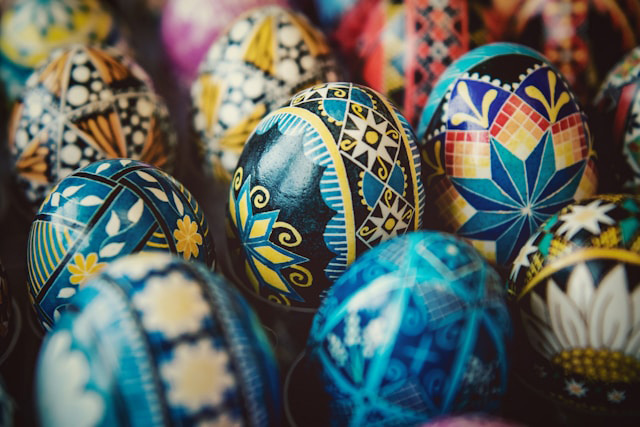
In Ukraine, the intricate art of decorating eggs, known as “Pysanky,” stands as a vibrant symbol of Easter and a cherished cultural tradition. This centuries-old practice, which originated in pagan times, was later transformed through religious syncretism into an integral aspect of Christian Easter celebrations.
Using techniques passed down through generations, pysanka artists meticulously craft designs on eggs, drawing from a rich palette of colors and motifs that often hold symbolic meanings, such as fertility, protection, and prosperity.
The term “Pysanka” derives from the Ukrainian verb “pysaty,” meaning “to write,” reflecting the delicate process of applying intricate patterns with wax-resist techniques.

This video will be loaded from YouTube.com, a third party. If you click "Play", you accept their terms of service, and their use of cookies.
The history of pysanky is as colorful as the eggs themselves. Ancient decorated eggs have been unearthed in Ukraine, some dating back to Scythian burials in the 4th century BCE. Over time, this tradition evolved, gaining artistic and cultural significance during the Kyivan Rus’ era.
Despite challenges, including suppression during the Soviet period, pysanky-making endured, preserved by Ukrainian diasporas in countries like Canada and the United States. Following Ukraine’s independence, the tradition experienced a revival, celebrated through events like the International Pysanka Congress.
Today, pysanky exemplifies the resilience and beauty of Ukrainian culture, with their delicate artistry continuing to enchant and inspire around the world.
6. Easter witches, Sweden and Finland
In Sweden and Finland, the legend of the Easter witches is a whimsical tradition rooted in folklore and ancient beliefs.
Known in Swedish as påskkärring (translated as “Easter hag” or “Easter witch”) and in Finnish as trulli, the lore tells of witches who fly on brooms to a mystical destination called Blockula (or Blåkulla) on Maundy Thursday or on the night between Holy Wednesday and Thursday, returning by Easter.
This age-old story historically symbolized forces beyond the ordinary and was once steeped in superstition aimed at warding off malevolent magic, a theme that links it to the spirit of other regional celebrations such as Walpurgis Night.
In modern times, the tradition has taken on a playful and community-based character. Today, children dress up as witches, old ladies, or even as elderly men to roam door-to-door on Maundy Thursday or Holy Saturday, mimicking the trick-or-treat tradition of Halloween.
They exchange handmade cards and heartfelt greetings for small treats, reviving the ancient customs in a joyful and inclusive manner. In Finland, where the practice is known as virvonta, the custom draws from the old Karelian Orthodox Christian traditions, blending the mystique of the past with the exuberance of contemporary celebrations.
7. Dance of Death, in Verges, Catalonia, Spain
In the medieval village of Verges near the Costa Brava in Catalonia, an eerie tradition transforms Maundy Thursday into an unforgettable spectacle known as the Dance of Death (La Danza de la Muerte de Verges, in Spanish).
Each Easter Thursday evening, villagers take part in a solemn procession that unfolds to the beat of resounding drums.
Clad in skeleton costumes and eerie masks, participants carry symbolic props such as scythes, ashes, and clocks, each element evoking the transient nature of life and the certainty of death. The ritual serves as a poignant reminder of the final judgment.

This video will be loaded from YouTube.com, a third party. If you click "Play", you accept their terms of service, and their use of cookies.
This distinctive event, deeply woven with both religious and cultural symbolism, attracts thousands of spectators each year. Held in the atmospheric setting of Verges’ medieval center, with its ancient walls and towers, the procession offers a haunting yet thought-provoking portrayal of life’s impermanence.
A modest admission fee grants visitors the chance to experience firsthand this captivating blend of tradition and artistry, making the Dance of Death one of Spain’s most compelling and enigmatic Easter customs.