

Planning a trip to the Italian Dolomites?
In this article, I’ve selected some of the best mountain towns that are great travel destination ideas, in my opinion, for both summer and winter adventures in the Dolomites.
Whether you’re after hiking trails beneath blue skies or want to visit for skiing days followed by cozy evenings, each of these towns will add a special feel to your vacation.
These unique spots offer local history, delicious food, and unforgettable moments right in the heart of the mountains.
Ready? Let’s get started!
Don’t miss: 20 Stunning Italian Mountain Villages and Small Towns You Have to Visit
Keep in mind: Our articles may contain errors, despite our best efforts. So, do a thorough research before deciding on a travel destination.
The Best Mountain Towns in the Dolomites (Italy): My Favorites
1. Cortina d’Ampezzo

This video will be loaded from YouTube.com, a third party. If you click "Play", you accept their terms of service, and their use of cookies.
Cortina d’Ampezzo is home to about 5,500 people, nestled in a wide mountain basin at 1,224 meters. It started out as a farming and grazing village back in the Middle Ages and later became part of the Venetian Republic.
In 1956, it hosted the Winter Olympics, which really put it on the map for skiers and hikers. The Ladin language and traditional folk costumes still thrive here, adding to its unique style.
Here you can take cable cars up to the Faloria and Tofane ridges. You can also admire the stunning views of the Three Peaks and enjoy wandering the pedestrian main street, lined with cafés, shops, and classic wooden chalets.
2. Ortisei (Val Gardena)

This video will be loaded from YouTube.com, a third party. If you click "Play", you accept their terms of service, and their use of cookies.
Ortisei, with around 4,700 residents at 1,220 m, began as a wood‐carving centre over 300 years ago. Local artists crafted intricate sculptures and toys from larch and walnut trees nearby.
The town gained fame as a holiday spot in the early 20th century and even hosted the 1970 Alpine Ski World Championships. Nowadays, you can hop on cable cars to reach the Seceda and Alpe di Siusi plateaus.
You can also explore the Museum de Gherdëina‘s carvings and fossils. And don’t miss the onion-domed church in the heart of its pedestrian streets.
3. Corvara in Badia

(Corvara in Badia, Italy – Photo by Eino Pitkälä)
Corvara in Badia sits at 1,568 meters and has just over 1,400 residents. It grew up around medieval Ladin farms beneath the Sassongher peak.
The village once lay along old mule tracks winding through the Dolomites, long before tourism took hold in the late 19th century. Nowadays, it anchors the Alta Badia ski circuit and offers summer trails through the Puez-Odle Nature Park.
Wood-carving workshops and small chapels highlight the local craft traditions. At the same time, ski lifts carry you into one of the world’s largest winter sports networks.
4. Santa Maddalena (Val di Funes)
Santa Maddalena is a tiny village of about 370 people sitting at 1,339 m. It’s best known for its small Gothic church, first mentioned in 1394.
The hamlet frames the Odle peaks beautifully. The Adolf Munkel Trail winds past rustic huts nestled in flower-spotted meadows.
Photographers come here for sunrise views, while hikers enjoy the calm fields and simple farmhouses.
5. San Candido (Innichen)
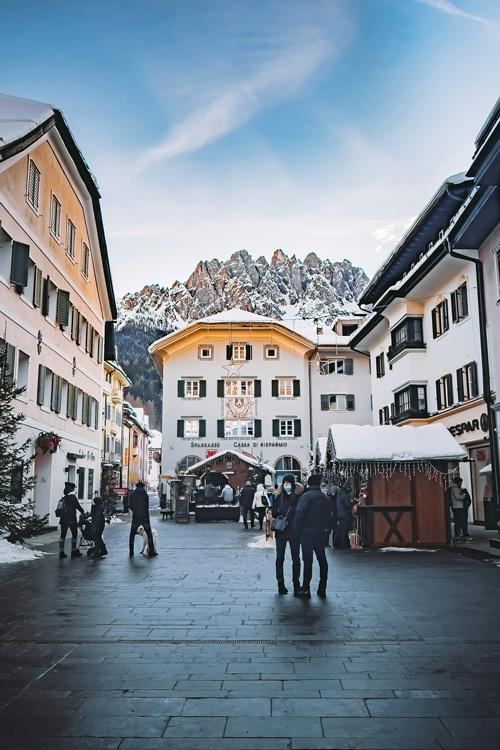
(San Candido, Autonomous Province of Bolzano, South Tyrol, Italy – Photo by Gabriele Merlino)
San Candido has 3,300 residents and is located in the Puster Valley on Italy’s Austrian border. A Benedictine abbey was founded here in 769, later coming under the Prince-Bishopric of Freising.
The town passed to Austria, then to Italy in 1919. Its pastel buildings and twin-towered Collegiate Church draw visitors who browse shops along the traffic-free main street.
In winter, ski lifts on Haunold and Baranci open well-groomed slopes. Summer brings cycling on the Drava path and guided nature walks in the Hochpustertal.
6. Canazei (Val Fassa)

(Canazei, Italy – Photo by Eino Pitkälä)
Canazei, at 1,465 meters, is home to around 1,900 people nestled in a green bowl surrounded by the Sella, Marmolada, and Sassolungo. Its name comes from the Latin word “cannicetus” (“cane thicket”), and the Ladin language still thrives here.
Once a 19th-century grazing camp, Canazei transformed into an Alpine resort and joined the Sellaronda ski tour by 1974. In summer, lifts carry hikers up to alpine lakes and wildflower meadows.
Mountain-bike paths and via ferratas challenge those who like a bit of adventure. Traditional inns serve speck-and-kasnocken dumplings in cozy wood-beam rooms.
7. Dobbiaco (Toblach)
Dobbiaco has about 3,460 people and sits at 1,241 meters, near Lago di Braies and Lago di Dobbiaco.
The town grew around its role as a market stop on routes from Venice to Innsbruck. Nowadays, its train station connects Italy and Austria, making travel easy.
Visitors skate or walk on the frozen lake in winter and paddle there during summer. Many also take on the Tre Cime circuit, either on foot or by bike, beneath the great Dolomites walls.
8. Auronzo di Cadore
Auronzo di Cadore, home to about 3,000 people, stretches along the Ansiei River where it feeds Santa Caterina Lake. Its name first appeared in documents from the 12th century as part of the Patriarchate of Aquileia.
The town passed under Venice and Austria before joining Italy in 1866. Over the centuries, valleys and castles have come and gone.
Today, Auronzo looks up at the Three Peaks (Tre Cime). Visitors often take toll roads or boats to reach the Lavaredo refuges.
Cross-country tracks, mountain tours, and beautiful forests add to the area’s amazing view.
9. Alleghe
Alleghe has about 1,100 residents and sits at the foot of Monte Civetta beside an emerald lake. This lake formed overnight in 1771 when a massive landslide blocked the Cordevole River.
In summer, boats and kayaks glide across the water, and anglers try their luck catching trout near the dam.
When winter comes, locals and visitors can skate on the frozen surface. Trails wind through forests and climb sheer rock cliffs.
A tiny ice hockey club adds a sporty vibe to the lakeside cafés, keeping a great tradition alive.
10. San Martino di Castrozza
San Martino di Castrozza has 560 residents at 1,487 meters and is a fraction of a bigger commune, nestled beneath the Pale di San Martino peaks. It originally grew from a medieval hospice that served travelers crossing the Rolle Pass.
Later, the area came under the control of Duke Sigismund of Austria and local counts. In the 1860s, English climbers “discovered” the range, sparking interest among mountaineers.
The first Alpine inn opened in 1873, marking the start of tourism here. Although WWI largely destroyed the town, locals rebuilt it in a nice alpine chalet style.
Today, cable cars take you up to flowery high pastures and trailheads beneath the jagged summit towers.