
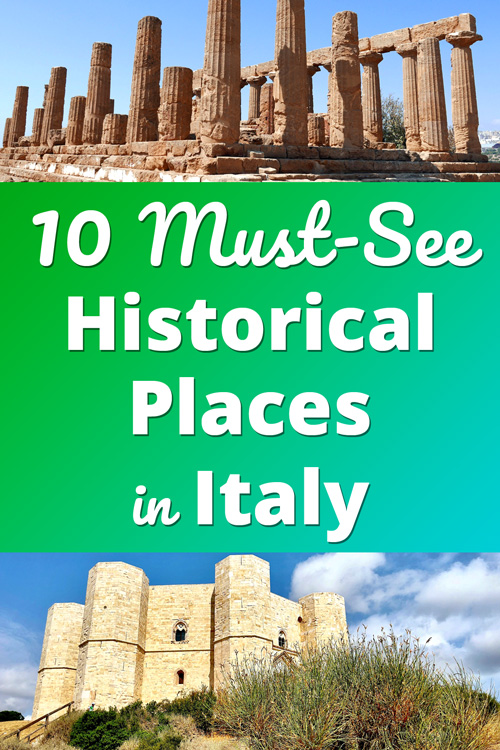
Italy is a land where history comes alive. Ancient ruins, majestic castles, and enchanting temples dot the landscape.
Here, we’re exploring 10 must-see historical sites that really capture the magic and mystery of Italy’s past. It’s a place where every stone seems to have something to say.
If you love history or just feel curious, these spots offer unforgettable adventures. Art, legend, and culture all mix together in ways you’ll remember.
Ready to plan your next trip? Here, the past feels just a little closer. Let’s begin!
Must read: 10 Best Towns & Villages in Lake Como, Italy that You Should Visit
(Click on the images to view them full-size.)
1. Florence Cathedral
The Florence Cathedral, known as the Duomo di Firenze, stands as a famous church in Florence, Italy.
Its full name? The Cathedral of Saint Mary of the Flower (in Italian, “Cattedrale di Santa Maria del Fiore”).

(Photo by Alexandra Smielova)
Construction kicked off way back in 1296. Builders followed a Gothic style, sticking to Arnolfo di Cambio’s design. The dome was Brunelleschi’s brainchild. It’s still the biggest masonry dome anywhere, which honestly feels wild.
Outside, the cathedral bursts with color. Marble panels in green and pink, edged in white, make the whole place pop. The building isn’t alone, either. It’s part of a cluster of big-deal structures in Piazza del Duomo.

(Photo by Joseph Quam)
You’ll find the Baptistery there, where baptisms happen. Giotto’s Campanile, a bell tower that practically scrapes the sky, stands nearby too. All these buildings together make up a UNESCO World Heritage Site, right in Florence’s historic center.
The cathedral ranks among the world’s largest churches. Tourists in Tuscany flock here, and honestly, who could blame them?
It’s also the main church for the Catholic Archdiocese of Florence. The archbishop leads the local church from here.
2. The Colosseum, Rome
The Colosseum, or Colosseo as folks in Italy call it, sits right in the center of Rome. Its name actually comes from an Ancient Greek word that means “giant statue.”
It’s the biggest ancient amphitheatre ever built. Even today, nobody’s made a larger one. Emperor Vespasian kicked off construction in AD 72. His son, Emperor Titus, wrapped things up in AD 80.

(Photo by Valeria Hutter)
Later on, Emperor Domitian made some tweaks. All three belonged to the Flavian dynasty, so sometimes people call the Colosseum the Flavian Amphitheatre.
Builders used travertine limestone, volcanic tuff, and this clever brick-faced concrete. At its busiest, the Colosseum could pack in between 50,000 and 80,000 people.
Usually, about 65,000 folks would show up for events. It was used for gladiator battles, animal hunts, battle reenactments, plays based on Roman myths, and even fake sea battles.

(Photo by Nella N)
After the early medieval period, those big shows stopped. Over the centuries, people used the Colosseum for all sorts of things, housing, workshops, a fortress, a quarry, and even a Christian shrine.
Earthquakes and stone robbers have roughed it up, but the Colosseum still stands as a symbol of ancient Rome. It’s one of the New 7 Wonders of the World.
The Colosseum draws tourists from all over the globe. Every Good Friday, the Pope leads a torchlit “Way of the Cross” procession that starts nearby. You’ll also spot the Colosseum on Italy’s 5 euro cent coin.
3. Pompeii, Naples, Campania
Pompeii sat just outside modern-day Naples, tucked into Italy’s Campania region. It was a lively Roman city, home to somewhere between 10,000 and 20,000 people.
Folks there took pride in their public spaces and filled their private homes with art and fancy furniture. Life must’ve felt pretty good, until it wasn’t.

(Photo by Kristīne Kozaka)
In 79 AD, Mount Vesuvius, looming nearby, erupted without warning. The city vanished beneath 4 to 6 meters (that’s 13 to 20 feet) of volcanic ash and pumice.
That thick blanket of ash froze Pompeii in time. It’s wild, really, almost everything stayed just as it was, giving us a rare peek into Roman daily life.
Archaeologists have spent years digging into Pompeii’s secrets. They’ve uncovered buildings, homes, and tiny shops that reveal all sorts of architectural quirks and slices of Roman living.

(Photo by Matteo Bellia)
Some organic stuff, like wood and bits of human remains, survived in the ash. As these things decayed, they left behind molds showing the final moments of people caught in the disaster.
For centuries, nobody remembered Pompeii. It wasn’t until the late 1500s that people stumbled upon it again.
Serious excavations kicked off in the mid-1700s, though early efforts sometimes did more harm than good. Today, Pompeii is a UNESCO World Heritage Site.
It draws about 2.5 million visitors a year, no surprise, really. There’s just something haunting and fascinating about wandering those ancient streets.
4. Juliet’s House, Verona
Juliet’s House in Verona sits on Via Cappello, just a quick stroll from Piazza delle Erbe. The place shot to fame because folks started tying it to Shakespeare’s Romeo and Juliet.
The earliest records go back to 1351. Back then, the building was actually an inn called “del Cappello.”

(Photo by Frank Eiffert)
A hat symbol on the archway made people in the 18th and 19th centuries think it had something to do with the Capulet family. That’s how the legend started, really.
In 1939, the city turned the building into a museum. Inside, you’ll spot medieval decorations, old frescoes, furniture, and a bunch of historical odds and ends.
They added a bronze statue of Juliet to the courtyard in 1973. That marked the museum’s big reopening.

(Photo by World of Magic)
Don’t miss: Beautiful Verona: 30+ Aesthetic Images of this Eternal Italian City
5. Bridge of Sighs, Venice
The Bridge of Sighs, in Venice, is an enclosed bridge made from white limestone. You’ll notice its small windows with stone bars. The bridge crosses a narrow canal called the Rio di Palazzo.

(Photo by Daniele Barison)
It links the New Prison (Prigioni Nuove) with the interrogation rooms in the Doge’s Palace. They built it back in 1600.
Antonio Contin designed the bridge. Oddly enough, his uncle Antonio da Ponte came up with the plans for the famous Rialto Bridge.
The name “Bridge of Sighs” comes from the Italian “Ponte dei sospiri.” Lord Byron, in the 19th century, translated it after seeing prisoners sigh as they caught their last glimpse of Venice before heading to their cells.

(Photo by Marialaura Gionfriddo)
See also: 35+ Amazing Venice Photos to Discover Italy’s Eternal Elegance
6. Valle dei Templi, Agrigento, Sicily
The Valle dei Templi, or “Valley of the Temples,” sits just outside Agrigento, Sicily. Despite the name, it’s perched on a high ridge, not tucked down in a valley.
This place stands out as one of the most striking examples of ancient Greek art and architecture from the Magna Graecia era. It’s a huge draw for travelers in Sicily, and it feels a bit surreal walking among those ruins.

(Photo by Kees Kortmulder)
UNESCO added the Valle dei Templi to its World Heritage list back in 1997. The archaeological park sprawls across 1,300 hectares, which makes it the biggest park of its kind in Europe and the Mediterranean.
Inside the Valle, you’ll find the remains of seven ancient temples, all built in the sturdy Doric style. The Temple of Concordia, dating from the 5th century BC, later became a church and still stands remarkably well.
There’s also the Temple of Hera, which suffered a fire in 406 BC. The Temple of Heracles is mostly gone now, except for eight stubborn columns.

(Photo by Renzo Vanden Bussche)
The Temple of Olympian Zeus went up to mark a military victory. The Temple of Castor and Pollux has turned into a symbol for modern Agrigento.
You’ll spot the Temple of Hephaestus, which time and weather have worn down quite a bit. The Temple of Asclepius once drew pilgrims who hoped for healing.
The park also features the Tomb of Theron, a big pyramidal monument. Scholars think it honors Romans who died in the Second Punic War.
People from around the world wander through the Valle dei Templi, trying to soak up the stories and mysteries of Sicily’s ancient past. It’s hard not to feel a little awed by how much history lingers in the air here.
7. Mole Antonelliana, Turin
The Mole Antonelliana stands out as a huge and iconic building in Turin, Italy. Its name comes from its architect, Alessandro Antonelli. The word “mole” in Italian hints at something monumental or just plain massive.
Originally, the Jewish community in Turin wanted it to be their synagogue. They hoped for a place that looked beautiful and made an impression.

(Photo by Evgheni Liuft)
Construction kicked off in 1863, right after Italy unified as a country. Antonelli kept tweaking his design, pushing the building to new heights, literally.
By the time they wrapped up in 1889, Antonelli was gone, but his vision lingered. The Mole reached a staggering 167.5 meters (that’s about 550 feet), which puts it among the tallest brick buildings anywhere in Europe.
These days, the Mole Antonelliana is home to the Museo Nazionale del Cinema, the National Museum of Cinema. Some folks even call it the tallest museum in the world, though that’s up for debate.

(Photo by David Salamanca)
On the ground floor, you’ll spot Catalan vaults on the ceiling, special arches you don’t often see in Italy. They were more common in Spain, so it gives the place a quirky, unexpected twist.
If you look closely at the Italian two euro cent coin, you’ll see the Mole Antonelliana right there. It’s even inspired logos for sports teams and big events, like the Winter Olympics.
Its bold design and layered history keep people talking. It’s no wonder the Mole remains one of Italy’s most unforgettable buildings.
8. Reggia di Venaria, Venaria Reale, Turin
The Reggia di Venaria Reale stands as one of the grand residences of the House of Savoy. It’s been on the UNESCO World Heritage List since 1997.
Originally, they built it as a royal hunting lodge, hence the Latin name “Venatio Regia,” meaning “royal hunt.” You’ll find the palace near Turin, right at the base of the Valli di Lanzo.

(Photo by David Salamanca)
This area is packed with forests and wildlife, which made it ideal for hunting back in the day. The first architect, Amedeo di Castellamonte, designed the palace after Duke Carlo Emanuele II commissioned it in the mid-1600s.
Construction started in 1659. Over time, the project grew with several additions.
Later on, architects like Michelangelo Garove and Filippo Juvarra joined in. They added new rooms, galleries, and even reimagined the gardens.
All these changes really shaped the palace into a breathtaking example of Savoy architecture. The outdoor spaces are just as impressive as the interiors.

(Photo by David Salamanca)
During wars, especially against the French, the palace took some hits. The military used it from 1850 to 1943, mainly for barracks and cavalry training.
Once the military left, the building fell into neglect and even suffered vandalism. Starting in the 1960s, though, restoration efforts kicked off, with more serious projects launching in the 1980s.
Now, the Reggia di Venaria ranks among Italy’s most important cultural sites. In 2018, over a million people visited, making it one of the most popular state museum sites in the country.
Its gardens? They snagged the title of the most beautiful public park in Italy in 2019. The palace also gets glowing reviews from guides like Michelin for its history and art.
9. Castel del Monte, Andria, Apulia
Castel del Monte, which means “Castle of the Mountain,” sits on a hill in Andria, in the Apulia region of southeast Italy. It’s a famous 13th-century castle, hard not to be struck by how unusual it is!
King Frederick II built it during the 1240s after inheriting these lands from his mother, Constance of Sicily. People used to think it was meant as a hunting lodge, but the castle was never really finished as planned.

(Photo by Massimo Virgilio)
There’s no moat or drawbridge. Some folks argue it wasn’t built for defense at all, though archaeological digs hint it might’ve once had a protective curtain wall.
The castle’s most striking feature? Its octagonal shape. Imagine an eight-sided prism, with a small tower perched at each corner.
Both floors have eight rooms each. In the center, there’s an eight-sided courtyard with vaulted ceilings that just begs for a closer look.

(Photo by Jordi Vich Navarro)
The design was ahead of its time. Some say King Frederick II picked up ideas about the Fibonacci series and the Golden ratio from Leonardo Fibonacci himself.
Over the years, Castel del Monte wore many hats. At one point, it served as a prison, and during a plague, people sought refuge inside its walls.
In the 18th century, workers stripped away its marble walls and columns. The castle slowly fell into disrepair. The Italian State bought it in 1876. Restoration kicked off in 1928.
Today, Castel del Monte is a UNESCO World Heritage Site. People celebrate it as a unique masterpiece of medieval military architecture.
Castel del Monte still fascinates historians and visitors from around the globe. Its mysterious design and odd shape have sparked plenty of legends and artistic works.
You can even spot it on the Italian one cent Euro coin. It stands as a reminder of King Frederick II’s innovative streak and, in my view, remains one of Italy’s most intriguing historic landmarks.
10. La Scarzuola, Montegabbione, Umbria
La Scarzuola sits tucked away in Umbria, in the Montegiove area of Montegabbione, Terni, Italy. It’s mostly known for its old convent, where, as the story goes, St. Francis of Assisi once spent some time.
Medieval chronicles claim that in 1218, St. Francis put up a little hut here. He planted a rose and a laurel, and apparently, a miraculous fountain sprang up.
The hut was built out of a marsh plant called “Scarza.” Over time, folks started calling the place La Scarzuola.

(Città Buzziana – Photo from flickr.com – CC BY-SA 2.0)
Later on, local nobles stepped in and built a church and a convent. The church eventually turned into an important burial spot for the counts of Marsciano and their families.
Fast forward to December 1957, Tomaso Buzzi, an architect from Milan, bought the whole place. He had this wild idea to build his own “ideal city” right next to the old convent.
Between 1958 and 1978, Buzzi went to work on what he called a “theater-city.” It was his personal take on a perfect city, borrowing ideas and symbols from ancient alchemy and secret societies.

(Photo from flickr.com – CC BY-SA 2.0)
He mixed in bits that remind people of Villa Adriana, Villa d’Este, and even the ancient Acropolis. The whole thing feels like a strange dream pulled from history and imagination.
La Scarzuola’s design is packed with mysterious symbols and odd shapes. The complex unfurls along a spiral path made from pergolas, which is supposed to symbolize a journey of learning and self-discovery.
Visitors start at a skeletal Pegasus statue. From there, they wind through outdoor theaters, terraces, and a bunch of other quirky spots.
You’ll find an amphitheater, a stage with a musical labyrinth, and even a miniature “city” with its own little Acropolis. Each area is meant to stand in for different parts of life and the human mind. It’s a lot to take in.
Buzzi’s style, called neo-mannerism, shows up everywhere. There are long staircases, weird proportions, and architectural details that look like fake ruins or something out of a surreal painting.
Buzzi died in 1981, and he didn’t finish everything. Marco Solari, his successor, stepped in and finished the project using Buzzi’s sketches.
La Scarzuola today? It’s this odd but fascinating blend of history, art, and mystery. The place just begs you to wander and wonder about all the hidden meanings tucked into its corners.