
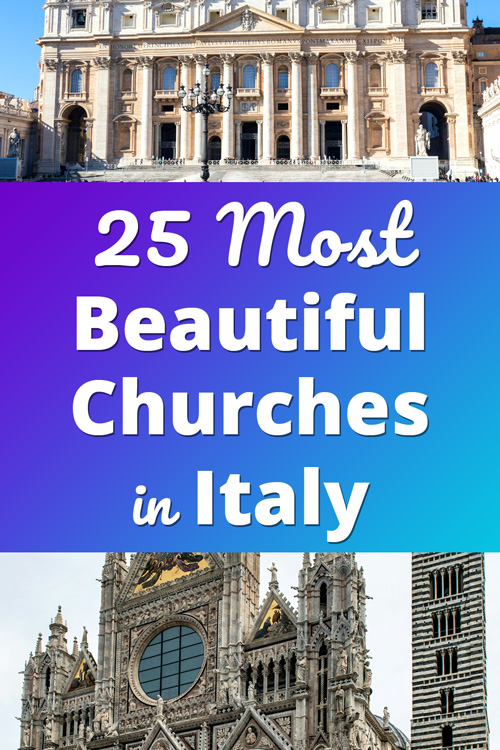
Italy’s sacred monuments aren’t just buildings but living stories of faith, art, and history.
Step inside any church and you’ll find breathtaking domes or intricate mosaics, each crafted with care over centuries.
If you wander through Florence, Rome, or Venice, you’ll see how human creativity and spiritual devotion collide in the most unexpected ways.
It’s worth taking a moment to visit these places, even if you’re not religious. There’s so much inspiring history tucked into every corner.
Here are 25 of the most beautiful churches in Italy:
Don’t miss: 10 Must-See Historical Places in Italy for Your Next Destination
(Click on the images to open them full-size.)
1. St. Mark’s Basilica (Basilica di San Marco), Venice
St. Mark’s Basilica, or the Basilica Cattedrale Metropolitana Patriarcale di San Marco Evangelista, is the city cathedral of Venice. It’s also the seat of the city’s patriarchate.
With its impressive campanile and the bustling Piazza San Marco right next door, the basilica anchors Venice’s main architectural scene. You can’t really picture Venice, or even the Veneto region, without it.

(Photo by Anatoly Grebenyuk)
This place doesn’t just show off Venetian art and Christian tradition; it’s also an Italian national monument. That’s a lot of history packed into one spot.
Built in the 11th century, people started calling it the “Golden Church” for good reason. The basilica’s filled with sacred relics, dazzling mosaics, and over-the-top design that all shout about the wealth and power Venice once had.
Back when the Venetian Republic still stood, the basilica served as the palatine church for the Doge’s Palace. The doge would appoint a primicerio to oversee it.

(Photo by Rodrigo dos Reis)
In 1807, thanks to a Napoleonic decree, the basilica became the city’s cathedral. The title moved over from San Pietro di Castello, and in 1821, a papal decree made it official.
St. Mark’s Basilica is an example of Italo-Byzantine architecture enriched with Romanesque carvings and subtle Gothic influences.
See also: 35+ Amazing Venice Photos to Discover Italy’s Eternal Elegance
2. St. Peter’s Basilica, Vatican City

(Photo by Martijn Vonk)

(Photo by With Paul)
Did You Know? St. Peter’s Basilica
- St. Peter’s Basilica is widely recognized as the largest church in the world, covering over 21,000 square meters.
- The basilica is built over the traditional burial site of Saint Peter, one of the foremost apostles of Jesus Christ.
- It is a masterpiece of Renaissance architecture, featuring contributions from renowned architects such as Michelangelo, Bramante, and Bernini.
- Its iconic dome, which dominates Rome’s skyline, reaches approximately 136.6 meters in height (448.1 ft).
- While one of the four major papal basilicas in Rome, the title of the official “mother church” is reserved for St. John Lateran.
3. Milan Cathedral (Duomo di Milano), Milan

(Photo by Roberto Dodu Timis)

(Photo by Martin Anselmo)
Did You Know? Milan Cathedral
- Construction began in 1386 and extended over nearly six centuries.
- The cathedral boasts over 3,400 statues, 135 spires, and 700 decorative figures.
- It is primarily built with Candoglia marble, contributing to its distinctive gleam.
- Milan Cathedral is the largest Gothic structure in Italy, marking it as an iconic symbol of the city.
- The rooftop offers breathtaking panoramic views of Milan and the surrounding Alps.
4. Florence Cathedral (Santa Maria del Fiore), Florence

(Photo by Max Nayman)

(Photo by Jude Arubi)
Did You Know? Florence Cathedral
- The construction spanned over 140 years, beginning in 1293, marking an enduring feat of engineering and art.
- Its dome, designed by Filippo Brunelleschi, remains the largest masonry dome in the world, constructed with over 4 million bricks.
- Built atop the remains of the earlier church Santa Reparata, it reflects Florence’s ancient architectural heritage.
- The exterior boasts a striking polychrome marble façade in hues of green, red, and white, making it an iconic landmark.
- Brunelleschi’s innovative engineering not only solved the dome’s construction challenges, but also heralded a new era in Renaissance design.
5. Basilica of Sant’Ambrogio, Milan

(Photo from flickr.com – CC BY 2.0)

(Photo from flickr.com – CC BY 2.0)
Did You Know? Basilica of Sant’Ambrogio
- Built between 379 and 386, it is one of Milan’s oldest churches, founded by St. Ambrose during the late Roman period.
- Originally known as “Basilica Martyrum,” it was erected over a burial ground for Christian martyrs, symbolizing early Christian heritage in Milan.
- It is one of the four basilicas commissioned by St. Ambrose, which underscores his pivotal role in shaping the city’s religious landscape.
- The basilica houses the famed Golden Altar by master goldsmith Vuolvinio (circa 835 AD), adorned with intricate reliefs depicting scenes from the lives of Christ and St. Ambrose.
- The richly decorated interior features remarkable mosaics, including those in the chapel of San Vittore in Ciel d’Oro, which displays the oldest known depiction of St. Ambrose.
6. Basilica of Santa Maria Novella, Florence

(Photo by Eleonora Altomare)
Did You Know? Basilica of Santa Maria Novella
- Constructed beginning in the mid-13th century on the site of a 9th-century oratory, Santa Maria Novella is Florence’s first great basilica and principal Dominican church.
- Its iconic façade, redesigned by Leon Battista Alberti between 1456 and 1470, showcases a harmonious blend of Gothic structure and Renaissance geometry using striking polychrome marble.
- The interior hosts an array of exquisite frescoes by renowned Gothic and early Renaissance masters, making it a veritable treasure trove of art and history.
- Originally part of a Dominican convent complex, the basilica has played a vital role in Florence’s religious and cultural life over the centuries.
- Successive renovations have layered the building with historic and architectural significance, reflecting the dynamic evolution of Florentine art.
7. Basilica of Santa Croce, Florence

(Photo by Lorenzo Moschi)
Did You Know? Basilica of Santa Croce
- Founded in 1294, the basilica stands as one of Florence’s most historically significant medieval churches.
- It is the largest Franciscan church in the world, earning its nickname as the “Temple of Italian Glories” due to the illustrious figures buried there.
- The interior is adorned with 16 chapels featuring remarkable frescoes by Giotto and his followers, underscoring its artistic heritage.
- Notable tombs within the basilica include those of Michelangelo, Galileo, and Machiavelli, connecting art, science, and politics in one sacred space.
- The gothic architectural design and later renovations reflect the dynamic evolution of Florentine artistic and cultural influences.
8. Basilica of San Francesco d’Assisi, Assisi

(Photo by Gary Walker-Jones)
Did You Know? Basilica of San Francesco d’Assisi
- The basilica is a papal minor basilica dedicated to St. Francis, featuring a unique two-level structure with a Lower Basilica housing the early relics and a more lavish Upper Basilica adorned with masterful frescoes.
- Construction began shortly after St. Francis’s death in 1226, marking the site as a major pilgrimage destination that embodies his humble legacy and spiritual ideals.
- The Lower and Upper Basilicas offer contrasting atmospheres: the former is austere and contemplative, while the latter vividly narrates the life and miracles of St. Francis through a series of dramatic fresco cycles.
- Set on a hill that St. Francis himself chose, the basilica transforms a once-neglected burial ground into a symbol of hope, redemption, and the enduring power of faith.
- Part of a UNESCO World Heritage Site, Basilica di San Francesco in Assisi continues to inspire visitors with its blend of spiritual significance and outstanding medieval artistry.
9. St. John Lateran (Basilica di San Giovanni in Laterano), Rome

(Photo by Nick Castelli)
Did You Know? St. John Lateran
- St. John Lateran is the oldest public church in Rome, originally consecrated in 324 AD by Pope Sylvester I.
- It is officially known as the “Mother Church” of the Catholic world, holding the highest ranking among Rome’s great basilicas.
- The basilica has undergone numerous renovations over the centuries, reflecting the evolution of Christian and Roman architectural styles.
- It is home to several significant relics, including the Holy Stairs (Scala Sancta), which are believed to be the steps Jesus ascended during his trial before Pontius Pilate.
- Despite its historical prominence, the basilica remains distinct from St. Peter’s Basilica, serving as the official ecclesiastical seat of the Bishop of Rome.
10. Basilica of Santa Maria Maggiore, Rome

(Photo by Nick Castelli)
Did You Know? Basilica of Santa Maria Maggiore
- Constructed in the 5th century, it is the only Roman basilica that has largely preserved its original paleochristian structure, later enhanced by successive architectural additions.
- It stands as one of Rome’s four major papal basilicas, embodying a unique fusion of early Christian, Byzantine, and later artistic influences.
- Legend has it that a miraculous snowfall on the Esquiline Hill in 352 AD signaled the Virgin Mary’s favor, inspiring the basilica’s foundation.
- The interior boasts magnificent early Christian mosaics and a stunning Cosmatesque pavement, reflecting centuries of artistic tradition.
- Dedicated to the Virgin Mary, it houses revered relics and icons such as the “Salus Populi Romani,” which is believed to protect Rome.
11. Basilica of San Clemente, Rome

(Photo from flickr.com – CC BY-SA 2.0)
Did You Know? Basilica of San Clemente
- Basilica di San Clemente is famed for its unique three-tiered structure, featuring a 12th-century basilica atop a 4th-century church, which in turn sits above ancient Roman structures, including a Mithraic temple.
- Archaeological excavations have uncovered these distinct layers, revealing a fascinating evolution from a site of pagan worship to an important early Christian sanctuary.
- The basilica’s faded frescoes and intricate mosaics offer compelling insights into the artistic transitions and cultural exchanges that have shaped Rome over the centuries.
- Located in Rome’s historic Monti district near the Colosseum, it provides visitors with an accessible and immersive journey through multiple eras of the city’s heritage.
- This stratified monument not only exemplifies Rome’s layered history but also serves as a testament to the city’s dynamic religious and architectural evolution.
12. Church of the Gesù, Rome

(Photo from flickr.com – CC BY-SA 2.0)
Did You Know? Church of the Gesù
- The Church of the Gesù is the mother church of the Jesuit Order, reflecting its central role in the Catholic Counter-Reformation.
- It was the first Jesuit church built in Rome, with construction beginning in 1568 and culminating in 1584.
- Celebrated as a masterpiece of early Baroque architecture, its façade, by Giacomo della Porta, set new stylistic standards in Rome.
- The interior features an illusionistic ceiling fresco, “The Triumph of the Name of Jesus,” created by Giovanni Battista Gaulli (Baciccia).
- Its innovative layout, with small chapels organized around the main altar, influenced the design of subsequent Baroque churches across Europe.
13. Church of San Luigi dei Francesi, Rome

(Photo from flickr.com – CC BY-SA 2.0)
Did You Know? Church of San Luigi dei Francesi
- The Church of San Luigi dei Francesi is the French national church in Rome, dedicated to St. Louis of France.
- Renowned for its Baroque design, the church was completed in 1589 and features an elegant façade enhanced by statues of prominent French historical figures.
- It houses three iconic Caravaggio paintings in the Contarelli Chapel: The Calling of Saint Matthew, The Inspiration of Saint Matthew, and The Martyrdom of Saint Matthew, that draw art lovers from around the world.
- Situated near Piazza Navona and the Pantheon, its location makes it a key highlight in Rome’s artistic and historical landscape.
- The church not only serves as a spiritual center but also as a repository of art and heritage, reflecting the rich ties between France and Rome.
14. Basilica of Santa Maria della Salute, Venice

(Photo by Claudio Schwarz)
Did You Know? Basilica of Santa Maria della Salute
- Constructed as an ex voto following the devastating Plague of 1630-1631, the basilica symbolizes Venice’s hope and gratitude to the Virgin Mary.
- Designed by Baldassare Longhena, it is hailed as a masterpiece of Venetian Baroque architecture with distinct Palladian influences.
- Strategically located at Punta della Dogana, its white Istrian stone façade dominates views of the Grand Canal and provides a striking contrast against the Venetian skyline.
- The building’s unique octagonal layout crowned by a prominent dome reflects both innovative design and deep religious symbolism.
- The annual Feast of the Madonna della Salute, celebrated on November 21st, underscores the basilica’s enduring cultural and spiritual significance.
15. San Miniato al Monte, Florence

(Photo from flickr.com – CC BY 2.0)
Did You Know? San Miniato al Monte
- One of Florence’s oldest surviving structures, originally consecrated around 1018 and a prime example of early Romanesque architecture.
- The façade showcases a striking bichromatic design using white and green marble, with five round arches supported by columns typical of Florentine style.
- Perched atop a hill, it offers breathtaking panoramic views of Florence, making it a beloved vantage point.
- The interior features a beautifully inlaid floor along with intricate medieval details that reflect centuries of artistic heritage.
- Dedicated to Saint Miniato, Florence’s first martyr, the basilica is steeped in historical legend and spiritual symbolism.
16. Basilica of San Vitale, Ravenna

(Photo from flickr.com – CC BY 2.0)
Did You Know? Basilica of San Vitale
- Commissioned in the mid-6th century (526–547 AD), it stands as a prime example of early Byzantine architecture in Western Europe.
- Its unique octagonal structure, crowned with a striking dome, symbolizes celestial harmony and innovative design.
- The interior is adorned with exquisite mosaics that portray biblical scenes and imperial figures, including Emperor Justinian I and Empress Theodora.
- These mosaics, celebrated for their intricate detail and vibrant colors, are among the finest examples of early Christian art.
- Recognized as a UNESCO World Heritage Site, the basilica reflects the rich cultural and historical legacy of Ravenna and its Byzantine heritage.
17. Basilica of San Paolo fuori le Mura, Rome

(from flickr.com – CC BY-SA 2.0)
Did You Know? Basilica of San Paolo fuori le Mura
- Basilica of San Paolo fuori le Mura is one of Rome’s four major papal basilicas, serving as a key symbol of Christian heritage.
- It was constructed in the 4th century over the traditional burial site of the Apostle Paul, whose tomb lies beneath the high altar.
- The basilica has undergone numerous renovations over the centuries, reflecting a rich blend of architectural styles and historical epochs.
- Its Latin-cross floor plan is complemented by stunning mosaics and artworks that showcase early Christian and medieval artistry.
- Despite its location in Rome, the basilica enjoys extraterritorial status as a property of the Holy See.
18. Basilica of Santa Maria in Trastevere, Rome

(from flickr.com – CC BY-SA 2.0)
Did You Know? Basilica of Santa Maria in Trastevere
- Legend holds that the church stands on the very site where a sacred gush of oil, the “fons olei”, miraculously emerged, marking one of Rome’s earliest Christian worship spaces.
- Traditionally founded by Pope Callixtus I, Santa Maria in Trastevere is celebrated as one of the oldest churches in Rome.
- The façade features elegant Romanesque elements and boasts striking mosaics, including depictions of the Virgin Mary.
- The medieval bell tower, complete with a working clock, is a prominent landmark that anchors the vibrant Trastevere district.
- Inside, exquisite frescoes and mosaics, some attributed to Pietro Cavallini, illustrate the rich legacy of early Christian art and devotion.
19. Naples Cathedral (Duomo di Napoli), Naples

Did You Know? Naples Cathedral
- Officially known as the Cathedral of Santa Maria Assunta, it is widely recognized as the home of the patron saint San Gennaro.
- Built in the 13th century, the cathedral exhibits a mix of Gothic, Baroque, and Neo-Gothic architectural styles due to successive renovations.
- It is renowned for the Miracle of the Blood, a revered event where the relic of San Gennaro’s blood is believed to liquefy.
- The interior is rich with sacred artworks and relics, highlighting its significant role in Neapolitan religious history.
- Located in the heart of Naples, the cathedral stands as a central symbol of the city’s spiritual and cultural heritage.
20. Santa Maria Gloriosa dei Frari, Venice

(Photo by GattoTere)
Did You Know? Santa Maria Gloriosa dei Frari
- It is a masterpiece of Venetian Gothic architecture, with an austere exterior that contrasts with its richly ornate interior.
- The basilica houses significant artworks by masters such as Titian and Giovanni Bellini.
- As one of the largest churches in Venice, its imposing structure embodies centuries of religious and artistic heritage.
- It features an impressive collection of funerary monuments and tombs honoring prominent Venetians.
- Notably, it preserves one of the only remaining rood screens in Venice, a rare architectural detail from the city’s medieval past.
21. Church of San Zaccaria, Venice

(from flickr.com – CC BY-SA 2.0)
Did You Know? Church of San Zaccaria
- Founded in the 9th century as a Benedictine convent, it was established to house the relics of Saint Zechariah, the father of John the Baptist.
- The church’s façade is a harmonious blend of Gothic and Renaissance styles, with contributions by architects such as Antonio Gambello and Mauro Codussi.
- It played a significant role in Venice’s civic and religious life, serving as a key pilgrimage site and hosting important ceremonies involving the Doge.
- The interior is adorned with elegant frescoes and intricate polychrome marble decorations.
- Located near Piazza San Marco and the Doge’s Palace, it stands as an iconic landmark that encapsulates the city’s historical and cultural evolution.
22. Cathedral of Monreale, Monreale, Sicily

Did You Know? Cathedral of Monreale
- Founded in 1174 by William II of Sicily and dedicated to the Nativity of the Virgin Mary, it stands as one of the greatest examples of Norman architecture.
- The cathedral is renowned for its vast and exquisite Byzantine mosaics, which adorn its interior with intricate biblical scenes and shimmering gold details.
- It was elevated to a metropolitan cathedral by a papal bull in 1182, emphasizing its significant role in the religious hierarchy of Sicily.
- The building exemplifies a unique fusion of Norman craftsmanship with Byzantine artistic traditions, reflecting the multicultural influences of medieval Sicily.
- Today, it forms part of the UNESCO World Heritage Site “Arab-Norman Palermo and the Cathedral Churches of Cefalù and Monreale”.
23. Palermo Cathedral, Palermo, Sicily

(Photo by Olya Velychenko)
Did You Know? Palermo Cathedral
- Founded in 1184 by the archbishop Walter Ophamil, Palermo Cathedral marks a pivotal transition in Sicilian history.
- Its architecture is a rich tapestry blending Norman, Gothic, and Catalan influences through centuries of modifications.
- Originally built over a former mosque, the cathedral embodies subtle Islamic design elements.
- Serving as a royal mausoleum, it houses tombs of notable Sicilian monarchs and emperors.
- It’s an integral part of the UNESCO World Heritage Site “Arab-Norman Palermo and the Cathedral Churches of Cefalù and Monreale,” celebrating its enduring cultural legacy.
24. Siena Cathedral (Duomo di Siena), Siena

(Photo by Wolfgang Weiser)
Did You Know? Siena Cathedral
- The cathedral is a stellar example of Italian Gothic architecture, renowned for its black and white striped marble that symbolizes Siena’s historic coat of arms and the virtues of humility and purity.
- The façade, known as the “facciatone,” remains unfinished.
- The intricately inlaid marble floor is composed of panels depicting scenes from the Old Testament.
- The Piccolomini Library, housed within the cathedral, boasts splendid frescoes and decorative details commissioned by the influential Piccolomini family.
- A unique feature is the depiction of the she-wolf, a symbol traditionally linked to Rome, appearing on both the mosaic floor and the façade.
25. Genoa Cathedral (Cattedrale di San Lorenzo), Genoa

(from flickr.com – CC BY-SA 2.0)
Did You Know? Genoa Cathedral
- It’s Genoa’s principal church and the seat of the Archdiocese, dedicated to Saint Lawrence.
- Consecrated by Pope Gelasius II in 1118, it stands on the site of earlier Christian worship dating back to the 5th-6th centuries.
- The façade features distinctive black and white stripes, a hallmark of Genoese medieval architecture.
- Rebuilt after a fire in 1296, it displays a dynamic blend of Romanesque and Gothic elements.