
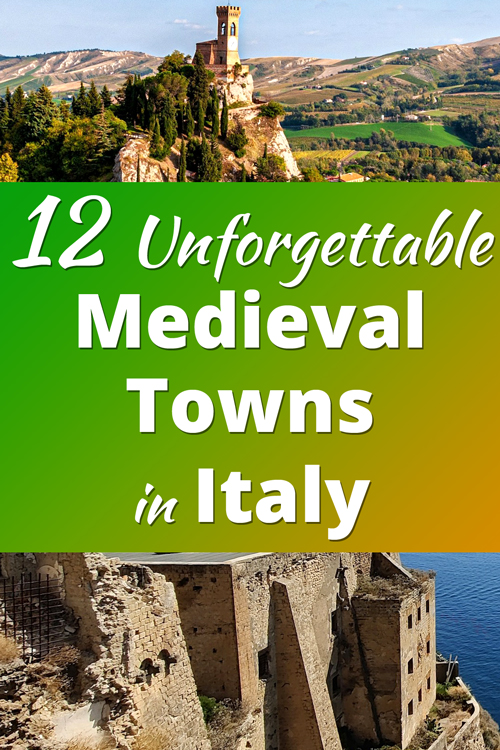
Italy’s medieval towns open a window to an old era. Every stone and cobblestone seems to whisper a story if you listen close enough.
Strolling along narrow streets hugged by centuries-old buildings it’s easy to picture lively marketplaces or grand feasts happening beneath those ancient towers.
In this article, we’re about to wander through 12 unforgettable Italian medieval towns.
Each one has its own stories and heritage, inviting you to step back in time and maybe, just maybe, start thinking about your next travel destination.
Let’s get started!
Don’t miss: 15 Must-See Castles in Northern Italy: High-Res Photos & Interesting Facts
(Click on the images to open them in full size.)
1. Verona

(Photo by Michael Martinelli)

(Photo by Michael Martinelli)
Did You Know? Verona
- Verona is more than 2,000 years old and was taken by the Romans in 89 BC.
- The city was once ruled by Charlemagne in 774.
- Verona became French in 1797, Austrian in 1798, and finally Italian in 1866.
- Romeo and Juliet is set in Verona, and visitors can see Juliet’s house and balcony.
- The Verona Arena is the third-largest Roman amphitheater in Italy.
See also: Beautiful Verona: 30+ Aesthetic Images of this Eternal Italian City

This video will be loaded from YouTube.com, a third party. If you click "Play", you accept their terms of service, and their use of cookies.
2. Bergamo

(Basilica di Santa Maria Maggiore – Photo by Adrian Botica)

(Basilica di Santa Maria Maggiore – Photo by Fabio Sangregorio)
Did You Know? Bergamo
- Bergamo is divided into two parts: the medieval Città Alta (Upper City) and the modern Città Bassa (Lower City)
- The city was founded by the Celtic tribe of Cenomani before becoming a Roman municipality around 49 BC
- Bergamo was part of the Venetian Republic from 1428 to 1797, influencing its architecture
- The Bergamo Alps begin just north of the city, offering stunning mountain views
- A funicular railway connects the Upper and Lower City, providing scenic rides
3. Alberobello

(Trulli – Photo by Brigi Harkányi)

(Trulli – Photo by Paolo Bendandi)
Did You Know? Alberobello
- Alberobello is famous for its trulli houses, which are built without mortar and have conical roofs
- Alberobello became a UNESCO World Heritage Site in 1996
- The Count of Conversano ordered peasants to build stone houses without mortar to avoid property taxes
- Many trulli roofs have symbols painted on them, representing religious, magical, or astrological beliefs
4. Procida

(Photo by Vincenzo De Simone)

(Photo by Francesco Marino)
Did You Know? Procida
- Procida was named Italy’s Capital of Culture in 2022
- The island is known for its vividly painted houses, creating a postcard-perfect view
- Procida has a rich maritime heritage, historically serving as a key naval hub
- The Terra Murata district is the oldest part of the island, offering stunning views
- Procida is less touristy than Capri and Ischia, making it a peaceful escape
5. Orvieto

(Photo by Gabriel Tovar)

(Orvieto Cathedral – Photo by T S)
Did You Know? Orvieto
- Orvieto sits atop a volcanic tuff, making it naturally fortified
- The city was a major Etruscan center, with artifacts still found today
- Orvieto has an underground city, with tunnels and escape routes
- The Orvieto Cathedral is famous for its striped façade of basalt and travertine
- Orvieto was one of the few places outside Rome with a papal residence
6. Matera

(Sassi di Matera, Matera – Photo by Giuseppe)

(Photo by Luciano Binetti)
Did You Know? Matera
- Matera is one of the oldest continuously inhabited cities in the world, dating back to the Paleolithic era
- The Sassi di Matera are ancient cave dwellings carved into limestone, forming a unique cityscape
- Matera was once known as the “Shame of Italy” due to extreme poverty, but it has since transformed into a cultural gem
- The city was named European Capital of Culture in 2019
- Matera has been a filming location for movies like The Passion of the Christ and No Time to Die
7. San Gimignano

(Photo by Bjorn Agerbeek)

(Photo by Bogdan Nanescu)
Did You Know? San Gimignano
- In the Middle Ages, San Gimignano had around 72 towers, built by noble families to display wealth and power. Today, 14 towers remain, giving the town its distinctive skyline.
- The town was a key stop on the Via Francigena, an ancient pilgrimage route connecting northern Europe to Rome, bringing wealth and trade.
- San Gimignano boasts well-preserved frescoes in sites like the Collegiata di Santa Maria Assunta, depicting biblical stories and medieval life.
- In 1348, the Black Death devastated the town’s population, leading to its decline and preservation of its medieval character.
- The area is renowned for Vernaccia di San Gimignano, a white wine documented since the 13th century and now protected under Italian wine regulations.
8. Brisighella

(Photo by Elisa Amadori)

(Photo by Fernando Mola-Davis)
Did You Know? Brisighella
- Brisighella is built on three gypsum hills, each crowned by a historic landmark: the Rocca Manfrediana, the Clock Tower, and the Monticino Sanctuary
- The town is famous for the Via degli Asini (Donkey Street), an elevated medieval road once used by mule drivers
- Brisighella is part of the Borghi più Belli d’Italia, a designation for Italy’s most beautiful villages
- The town is known for its DOP olive oil, considered one of the finest in Italy
- Brisighella hosts numerous festivals celebrating local food, history, and traditions
9. Montepulciano

(Photo by Bogdan Nanescu)

(San Biagio Church – Photo by Richard Hedrick)
Did You Know? Montepulciano
- Montepulciano is famous for its Vino Nobile di Montepulciano, a prestigious red wine with centuries of history
- The town’s Piazza Grande is the heart of Montepulciano, surrounded by Renaissance palaces and a historic well
- Montepulciano was a strategic medieval stronghold, often contested between Florence and Siena
- The Church of San Biagio, built in the 16th century, is considered a masterpiece of Renaissance architecture
- Montepulciano was a filming location for New Moon, the second movie in the Twilight saga
10. Lucca

(Photo by Kateryna Senkevych)

(Photo by Kateryna Senkevych)
Did You Know? Lucca
- Lucca was founded by the Etruscans and later became a Roman colony in 180 BC
- The city is surrounded by well-preserved Renaissance-era walls, which remain intact today
- Napoleon took control of Lucca in 1805 and installed his sister Elisa Bonaparte as ruler
- Lucca was a major center for silk production in medieval and Renaissance Italy
- The city is the birthplace of composer Giacomo Puccini, known for operas like La Bohème and Madama Butterfly
11. Parma

(Photo by Lorenzo Bignami)

(Photo by Kateryna Kamenieva)
Did You Know? Parma
- Parma is the birthplace of Parmigiano Reggiano cheese
- The city was founded by the Romans in 183 BC as “Colonia Julia Augusta Parma”
- Parma is deeply connected to opera and classical music, its province being the birthplace of Giuseppe Verdi
- The Baptistery of Parma is made of pink Verona marble, which changes color depending on the light
- The Treaty of Fontainebleau gave the Duchy of Parma to Napoleon Bonaparte’s wife Marie Louise of Austria, who ruled it for decades
12. Siena

(Photo by Laura Lugaresi)

(Photo by Héloïse Delbos)
Did You Know? Siena
- Siena was founded by the Etruscans and later became a Roman colony.
- The historic center of Siena is a UNESCO World Heritage Site.
- Siena is home to Monte dei Paschi di Siena, the world’s oldest bank, founded in 1472.
- The Palio di Siena is a traditional medieval horse race held twice a year in the Piazza del Campo.
- Siena’s cathedral was originally planned to be the largest in Christianity but was never completed.