
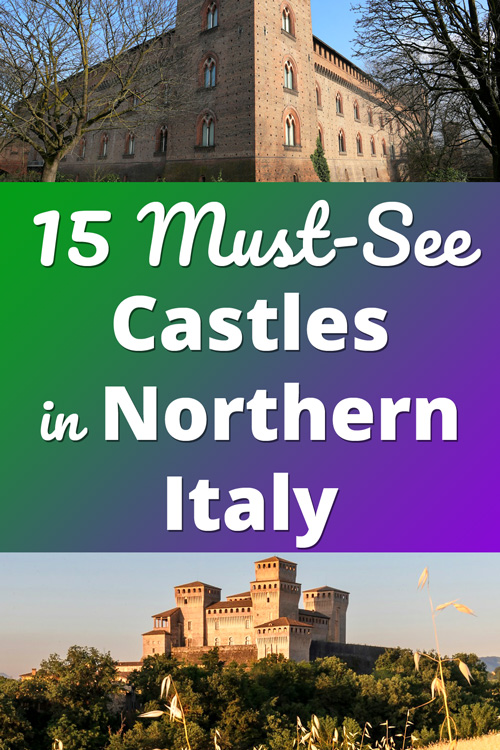
Northern Italy brims with history. Majestic castles rise up as silent witnesses to centuries of intrigue, power, and artistry.
Noble families and daring rulers once called these fortresses home. They’ve survived wars, political upheavals, and all the unpredictable twists of time.
Each castle tells its own story through imposing walls and ornate halls. Some perch on scenic hills, others guard tranquil lakes, and a few nestle within charming towns.
These places invite you to step back into the past. If you’re curious, get ready to explore 15 must-see castles that really capture the essence of Northern Italy’s legacy.
And, who knows, maybe this article will help you plan your next travel adventure!
Don’t miss: The 25 Most Beautiful Churches in Italy
(Click on the images to open them in full size.)
1. Castello Visconteo (Pavia, Lombardy)

(Photo by Paolo Comai)

(Photo by Paolo Comai)
Castello Visconteo in Pavia, Lombardy, is an emblem of medieval power mixed with refined elegance. The Visconti family built it in the mid-14th century.
Its robust stone façade, lined with iconic Gothic biforas, wasn’t just for defense. The castle also doubled as a luxurious residence.
Local lore whispers about secret chambers and hidden passages. Maybe they once hosted clandestine gatherings or strategic meetings, who knows?
Today, when you wander through those storied halls, you can almost feel the pulse of ancient intrigues. It’s easy to imagine the grand hunts that once took place across the castle’s expansive grounds.
Read also: 10 Must-See Historical Places in Italy for Your Next Destination
2. Castello di Masino (Caravino, Piedmont)


Castello di Masino stands in Caravino, Piedmont. This striking fortress dates back to the 11th century, built by the noble Valperga family.
Through the ages, the castle shifted from a rugged medieval stronghold into a more graceful residence. Renaissance and neoclassical touches gradually softened its look.
Step inside and you’ll see richly frescoed halls and an intricate hedge maze. There’s even a display of vintage carriages, all of it weaving together stories of aristocratic luxury and Piedmontese heritage.
It feels like the place invites you to peek into the legacy of the region’s nobility.
3. Castello Estense (Ferrara, Emilia Romagna)

(Photo from flickr.com – CC BY-SA 2.0)

(Photo from flickr.com – CC BY 2.0)
Castello Estense in Ferrara, Emilia Romagna, is an architectural gem. It’s steeped in both martial and artistic splendor.
Niccolò II d’Este commissioned the castle in 1385 after facing internal revolts. The fortress shows off a distinctive quadrangular design, with four imposing towers and a water moat.
Originally, it served as a formidable stronghold. But over the centuries, the castle transformed into a more refined ducal residence.
Vibrant Renaissance art found a home here. Spaces like the Sala dell’Aurora dazzle with evocative frescoes.
Every stone in Castello Estense seems to whisper tales of power and revolt. The enduring legacy of the Este family lingers, inviting visitors to step back into a time when military might and artistic ambition collided right in the heart of Ferrara.
4. Castello di Duino (Duino, Friuli Venezia Giulia)

(Photo from flickr.com – CC BY 2.0)
Castello di Duino sits perched on a cliff in Friuli Venezia Giulia, and it’s hard not to be a little awestruck by the view. The place blends medieval strength with a kind of artistic charm that’s kept people coming back for ages.
Noble families, including the Princes von Thurn und Taxis, once called this fortress home. You’ll spot striking Gothic architecture and a Palladian staircase that feels almost too elegant for a castle.
Rainer Maria Rilke found his muse here and wrote his famous “Duino Elegies” within these walls. The gardens spread out over several levels, and the sea views are just, well, they’re really something.
History and nature seem to mix together in every corner. Whether you’re into art, a bit of romance, or just curious, wandering these halls and terraces feels like stepping into another world.
5. Castello Sforzesco (Milan, Lombardy)

(Photo by Egemen Şahin)

(Photo by Jakub Kroul)
Castello Sforzesco in Milan is a striking symbol of the city’s rich history. It started out on the remnants of ancient Roman fortifications. Over the centuries, this red-brick fortress changed a lot.
First, it served as a medieval stronghold under the Visconti. Later, the Sforza family transformed it into a Renaissance palace.
The castle’s spot in the heart of Milan made it more than just a defensive structure. It turned into a lively hub for both artistic and political innovation.
Legendary figures, including Leonardo da Vinci, left their mark on its decorative splendor.
Now, when you wander through its courtyards and museums, you can almost feel the layers of Milanese heritage beneath your feet. Military might, art, and a touch of cinematic intrigue all seem to blend together here.
6. Castello di Racconigi (Racconigi, Piedmont)


Castello di Racconigi sits quietly in the scenic town of Racconigi, Piedmont. It’s a striking blend of historical layers and aristocratic flair.
People first established the castle in the 11th century. Over time, architects like Carlo di Castellamonte and Pelagio Palagi stepped in and transformed it.
What began as a fortified medieval residence slowly became a sophisticated summer retreat for the Italian royal family. The interiors are lavish: an ornate throne room, and a swirl of Baroque and Neoclassical details.
Outside, the gardens stretch wide in that English style, with winding canals and peaceful corners. The place still feels like it’s echoing the refined social life of its noble past.
7. Fénis Castle (Aosta Valley)

(Photo from flickr.com – CC BY 2.0)

(Photo from flickr.com – CC BY 2.0)
Fénis Castle sits right in the middle of the Aosta Valley. Built in the 14th century by the influential Challant family, it really captures the spirit of medieval nobility.
Its battlements and turreted towers stand out immediately. The courtyards, covered in detailed frescoes, give you a vivid sense of that era’s architectural ambition.
8. Scaligero Castle in Sirmione (Sirmione, Lombardy)

(Photo by Daniel R.)

(Photo from flickr.com – CC BY-SA 2.0)
Scaligero Castle in Sirmione stands out as a striking emblem of medieval fortitude. There’s also a real sense of lakeside romance about the place.
The Della Scala family built it back in the 14th century. Its chunky towers, those unmistakable swallowtail battlements, and even the original drawbridge all bring to mind an era of chivalry and tough defenses.
You’ll find the castle perched right at the gateway to Sirmione’s historic center. It overlooks the shimmering waters of Lake Garda, which just adds to its charm.
The castle once protected this coveted peninsula. Over time, ghost stories and local myths have wrapped the place in an extra layer of mystery, and who doesn’t love a good legend?
Read also: 10 Best Towns & Villages in Lake Como, Italy that You Should Visit
9. Castello del Buonconsiglio (Trento, Trentino-Alto Adige)

(Photo from flickr.com – CC BY 2.0)

(Photo from flickr.com – CC BY 2.0)
Castello del Buonconsiglio in Trento is a bit of an architectural patchwork. You can see how it’s changed over the centuries, morphing from a medieval fortress into the grand residence of the Prince-Bishops.
The oldest part, called Castelvecchio, stands out with its tough, round tower. Later on, they added the Renaissance Magno Palazzo, which feels like a whole different world.
Torre Aquila is another highlight. It’s famous for the “Ciclo dei Mesi,” a set of frescoes that bring the changing seasons to life.
This mix of sturdy defenses and elegant art tells the region’s rich history. The castle doesn’t just sit there but it actually feels like it’s sharing Trento’s past with anyone willing to listen.
10. Castello Sforzesco of Vigevano (Vigevano, Lombardy)

(Photo from flickr.com – CC BY-SA 2.0)

(Photo from flickr.com – CC BY-SA 2.0)
Castello Sforzesco of Vigevano sits majestically on a natural terrace, gazing out over the Ticino Valley. It’s a striking blend of medieval fortifications and ducal splendor, carrying the weight of centuries.
The castle started as part of the town’s early defenses. During the mid-15th century, the Sforza family transformed it into a refined noble residence.
Its layout weaves together several interconnected buildings, spreading across more than two hectares. The dramatic entrance tower stands out, often linked to Renaissance influences and even whispers of Bramante’s touch.
I love how the castle slips almost quietly into Vigevano’s modern cityscape. It invites curious wanderers to imagine secret passageways and hidden meetings that might have once filled its halls.
11. Castello di Agliè (Agliè, Piedmont)


Castello di Agliè sits quietly in the Canavesana area of Piedmont. Its story begins way back in the 12th century, when the powerful San Martino family put down the first stones.
Big changes came in 1667. Count Filippo San Martino stepped in, and with Amedeo di Castellamonte’s designs, the place gained a more elegant shape, think twin courtyards and a two-story gallery that connects the castle right to the parish church.
In the 19th century, the Savoy family took over. They really went all out, bringing in lavish Baroque interiors and sprawling English-style gardens. Even now, those gardens have a way of making people stop and stare.
And then there are the stories. Locals whisper about hidden chambers and secret passages, supposedly used in rougher times. It’s that air of mystery that keeps drawing folks back to Castello di Agliè.
12. Torrechiara Castle (Torrechiara, Parma, Emilia Romagna)

(Photo by Samuele Bertoli)

(Photo by Samuele Bertoli)

(Photo by Samuele Bertoli)
Torrechiara Castle sits high above the rolling hills near Parma in Emilia Romagna. It’s not just a fortress but a poetic tribute to a legendary love story that still stirs the imagination.
Pier Maria Rossi, a nobleman with a flair for the dramatic, built the castle between 1448 and 1460. He somehow managed to blend military grit, think twin lines of thick defensive walls and elegant towers, with a touch of romance that’s hard to ignore.
The real showstopper here is the “Camera d’Oro” (Golden Chamber). Its frescoes are breathtaking, capturing the passion between Rossi and his beloved Bianca Pellegrini in a way that feels almost too intimate for a fortress.
Today, people wander through secret corridors and gaze out over vineyards that seem to go on forever. There’s an enduring mystery in those storied walls.
It’s hard not to get swept up in the blend of art, history, and romance that defines this place.
13. Castelvecchio (Verona, Veneto)

(Photo by Lisa Boonaerts)

(Photo by Chiara Guercio)
Castelvecchio in Verona is a beautiful medieval fortress. Cangrande II della Scala had it built in the 14th century, intending it to serve as both a defensive stronghold and a noble residence.
Its red-brick walls grab your attention right away. Those M-shaped battlements and the fortified bridge stretching over the Adige River really show off the Scaliger dynasty’s strategic mindset.
The castle’s story didn’t stop there. Through the centuries, it changed roles, used as a barracks during Napoleonic and Austrian rule, and later restored into a museum that now displays Veronese art and sculpture.
Wandering through its halls, you’ll come across works by artists like Pisanello and Mantegna. Carlo Scarpa’s mid-20th-century redesign brings a fresh twist, blending medieval grandeur with a modern exhibition vibe. It’s a place where history, art, and architecture all collide.
14. Castello di Moncalieri (Moncalieri, Piedmont)

(Photo from flickr.com – CC BY 2.0)

(Photo from flickr.com – CC BY 2.0)
Castello di Moncalieri sits just outside Turin. This fortress has roots stretching back to the 12th century.
Tommaso I of Savoy first built it for defense. Later, the House of Savoy turned it into a lavish royal residence.
The castle has seen a lot through the centuries. In 1849, King Vittorio Emanuele II signed the Proclama di Moncalieri here, a pretty big deal in Italian politics.
Now, Castello di Moncalieri is a UNESCO World Heritage site. Visitors wander through its grand halls, admire the intricate frescoes, and stroll the sprawling gardens. There’s a certain mystery to the place, too.
15. Castello di Vezio (Varenna, Lombardy)

This video will be loaded from YouTube.com, a third party. If you click "Play", you accept their terms of service, and their use of cookies.
Castello di Vezio sits perched on a hill above Varenna, Lombardy. This medieval fortress has watched over Lake Como for centuries.
People first built it as a military outpost. Later, it became a strategic stronghold, offering panoramic views of the lake and the mountains that surround it.
One of the most intriguing features? Eerie white plaster sculptures scattered around the grounds. Locals call them the “ghosts of Vezio,” and they add a mysterious, artistic vibe to the whole place.
Visitors today can wander through the tower and explore the underground passages. If you’re into falconry, there are exhibitions to check out too.
All the while, you get to soak in scenery that’s breathtaking. Castello di Vezio feels like one of those places you don’t just visit, you remember.