


The Statue of Liberty is one of America’s most iconic landmarks. But have you ever wondered what’s actually inside this colossal monument?
Let’s dig into the fascinating interior of Lady Liberty.
From her construction secrets to the sights visitors can catch inside, there’s a lot more to this symbol of freedom than meets the eye.
Let’s begin!
Read also: 100+ Fun & Interesting Facts about the USA: Freedom, Baseball, & Apple Pie
The History Behind the Statue of Liberty

This video will be loaded from YouTube.com, a third party. If you click "Play", you accept their terms of service, and their use of cookies.
The statue’s official name is Liberty Enlightening the World, though it’s universally known today as the Statue of Liberty.
This magnificent monument was a gift to the United States from the people of France in 1886, symbolizing the friendship between the two nations and the shared values of liberty and democracy.
Location and Significance
The Statue of Liberty sits on Liberty Island in the Upper Bay, also known as New York Harbor, positioned between New York and New Jersey.
This strategic location made it one of the first sights that greeted immigrants sailing into America between 1892 and 1954. For millions of people arriving at nearby Ellis Island, Lady Liberty represented hope, freedom, and the promise of a new beginning.
Don’t miss: Exploring the Gateway Arch in St. Louis, Missouri: What’s Inside & How It Was Built
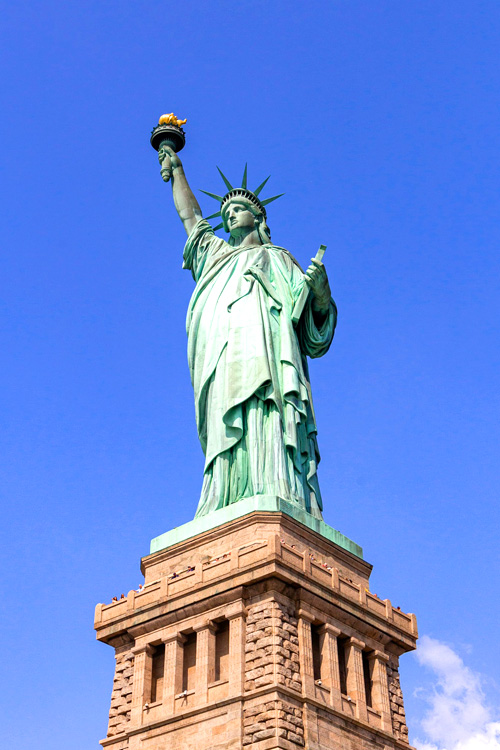
(Statue of Liberty National Monument, New York, USA – Photo by Maxim Klimashin)
Symbolic Features
Liberty holds several meaningful objects that represent American ideals:
- Right hand: Holds a torch symbolizing enlightenment
- Left hand: Carries a tablet inscribed with the date of the Declaration of Independence in Roman numerals
- Feet: Features a broken shackle and chain (not visible from ground level) symbolizing the end of slavery
The Impressive Dimensions of Lady Liberty
The Statue of Liberty measures 46 meters tall (150,9 feet) from base to torch. When measured from ground level, including the pedestal, the total height reaches 93 meters (305 feet), equivalent to a 20-story building.
To put this in perspective, a full-grown adult would only reach the height of the statue’s big toe.
When completed in 1886, it held the title of the world’s tallest statue. While it has since been surpassed by monuments like the Statue of Unity in India, it remains one of the most recognizable statues globally.
The Construction Process: From Clay to Copper
The Four-Stage Design Process
French sculptor Frédéric Auguste Bartholdi employed a methodical approach to creating this masterpiece:
- Initial clay model: Just 1.2 meters high
- Plaster version: Twice the size of the clay model
- Quarter-scale model: One-fourth the size of the final statue
- Full-size version: Built in pieces to fit inside the workshop
At each stage, Bartholdi refined the details, ensuring perfection in the final product.
The Repoussé Method
The statue’s exterior consists of copper sheets just 2.4 millimeters thick, less than the combined thickness of two American pennies. Workers used a technique called repoussé to shape the copper:
- Pieces of the full-size plaster model served as templates
- Wooden molds were built next to these plaster sections
- Copper sheets were hammered into the molds until they matched the desired shape
- Iron straps on the interior provided additional support
The Iconic Green Color
Originally, the Statue of Liberty was the color of a penny: that distinctive copper brown. However, within approximately 20 years, exposure to air and rain oxidized the metal, creating the iconic green patina we recognize today.
Read next: Where to Go in the USA: 13 Destination Ideas Month by Month (+ Cheat Sheet)
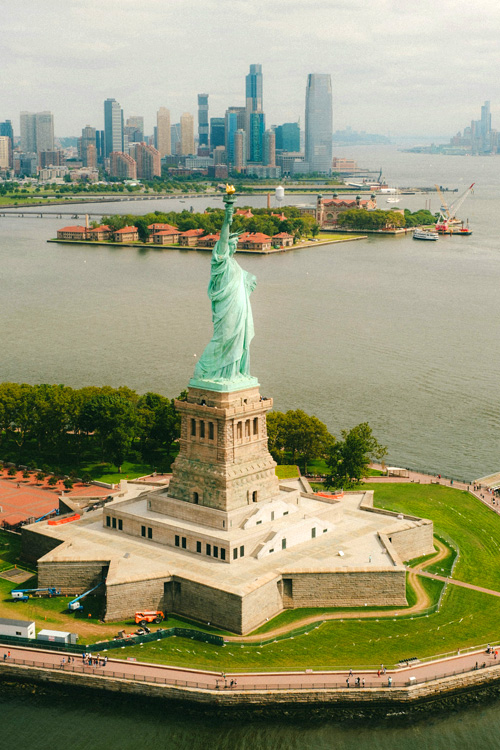
(Statue of Liberty National Monument, New York, USA – Photo by Chris Leipelt)
The Engineering Marvel: Gustave Eiffel’s Support Structure
The copper exterior pieces couldn’t support their own weight, necessitating an innovative internal framework designed by Gustave Eiffel. Yes, the same engineer who would later create the famous Eiffel Tower in Paris.
The Internal Framework
- Central iron pylon: Serves as the “spine” of the statue
- Support beams: Smaller beams radiate from the central pylon to support the copper exterior
- Flexibility: The structure allows the statue to sway up to 12 centimeters at the top in strong winds
The Transatlantic Journey
The construction in Paris, France, took nearly 10 years to complete. Once finished, the statue was disassembled into 350 separate pieces for shipping across the Atlantic Ocean. Reassembly on top of the pedestal in the United States required an additional four months.
Interestingly, while France funded the statue itself, the United States was responsible for paying for the pedestal. The island, originally called Bedloe’s Island, was later renamed Liberty Island.
Getting to Liberty Island
Unless you’re an exceptional swimmer (which is not recommended), the ferry is your only option for reaching Liberty Island. Ferry services depart from two locations:
- Liberty State Park in New Jersey
- The Battery at the southern tip of Manhattan
The journey takes approximately 15 minutes. Liberty Island itself covers just under 15 acres and includes several facilities for visitors.
What You Can See Inside the Statue of Liberty
Island Amenities
Liberty Island offers multiple attractions beyond the statue itself:
- Flagpole Plaza
- Information Center
- Café and bookstore
- Gift shop
- Statue of Liberty Museum (opened in 2019)
The Base and Fort Wood
The star-shaped base of the statue consists of the remnants of Fort Wood, a military installation from the early 1800s that now serves as the foundation for the monument.
Ticket Options and Access Levels
Pedestal Ticket
With a pedestal ticket, you can access:
- The top of the statue’s base
- All seven floors inside the pedestal
- The observation deck
To enter the statue, you’ll pass through the Centennial Doors into the pedestal lobby, where the original torch was once displayed before being moved to the museum in 2019.
Crown Ticket
For those seeking the ultimate Statue of Liberty experience, crown tickets allow access to the very top of the statue. These tickets are more difficult to obtain and typically require reservations weeks or even months in advance.
Note: Since the pandemic, public access to the interior of the pedestal and statue has been restricted, though visitors can still explore the island. Check current access policies before planning your visit.
Climbing Inside Lady Liberty
The Pedestal Journey
Visitors have two options for ascending the pedestal:
- Elevator: Available for those who prefer not to climb
- Stairs: 192 steps to the top of the pedestal
The pedestal contains seven floors, labeled 1P through 7P. Notable stops include:
- Level 3P: Outdoor viewing area
- Level 6P: Official observation deck with 360-degree views
- Level 7P: Starting point for crown access
The Crown Climb
For those with crown tickets, level 7P is where the adventure truly begins. The Double Helix Stairway features two spiraling staircases, one for ascending and one for descending.
This narrow passage winds through the middle of the support structure designed by Gustave Eiffel.
The climb is not for the faint of heart or those afraid of heights. The tight quarters and steep stairs make for a challenging ascent, though rest areas are positioned along the way.
For emergencies, an elevator exists inside the statue, though it’s not available for regular public use.
Renovations and Preservation
The Statue of Liberty has undergone several renovations throughout its history to ensure its preservation. One significant renovation in the 1980s involved replacing the torch, which had been damaged and was leaking rainwater.
The original torch remains on display in the museum, offering visitors a chance to see this piece of history up close.
Conclusion
The interior of the Statue of Liberty is as impressive as its exterior, featuring remarkable engineering, historical significance, and breathtaking views.
Whether you’re exploring the pedestal’s observation deck or making the challenging climb to the crown, visiting the inside of Lady Liberty offers a unique perspective on this enduring symbol of freedom.
While access restrictions may vary, the Statue of Liberty continues to welcome visitors from around the world, just as it has welcomed generations of immigrants seeking a better life in America.
Read next: Exploring 12 Cute, Small Towns in New York State to Visit for a Perfect Road Trip