
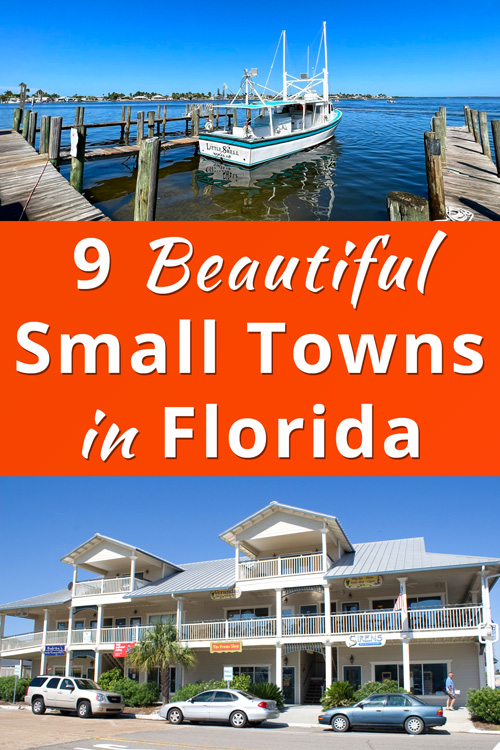
Small towns in Florida are packed with history and personality: a whole other side just waiting to be found!
Because when people think of Florida, they usually picture crowded theme parks or white-sand beaches.
In these 9 towns that we’ll explore in this article, you’ll walk through Spanish forts or stumble on the story of an old ice-making invention.
Turn a corner, and you might catch a splash of color from a local art gallery, or spot oyster boats tied up at old docks.
Maybe you’ll show up during a festival that celebrates something unexpected: antiques, sea cows, who knows? Or you could just end up swapping stories with someone whose family’s been around for generations.
If you’re curious for a different taste of the Sunshine State, these towns serve up stories and scenes you definitely won’t find on the usual tourist maps.
Let’s get started!
Don’t miss: 17 Best Small Towns in Texas that Must Be on Your Bucket List
Keep in mind: Our articles may contain errors, despite our best efforts. So, do a thorough research before deciding on a travel destination.
Beautiful Small Towns in Florida: My Favorites
1. Winter Park

This video will be loaded from YouTube.com, a third party. If you click "Play", you accept their terms of service, and their use of cookies.
Winter Park started back in 1883 as Florida’s first planned community. Wealthy northerners built it to dodge those cold winters up north.
The city shows off with brick-lined Park Avenue and the oldest college in Florida, Rollins College. Central Park sits at the heart of things, and you’ll sometimes spot Greek peacocks wandering under the giant oaks.
People still rave about the Winter Park Sidewalk Art Festival every spring. It draws massive crowds.
The Morse Museum’s Tiffany glass collection is a real highlight. It’s one of those rare spots where you can just stare at the art and feel kind of lucky.
Now, about 30,000 people live in Winter Park. They get to enjoy the chain of sparkling lakes and those historic neighborhoods.
Read next: 17 Cute, Small Towns in California You Have to See
2. Safety Harbor

This video will be loaded from YouTube.com, a third party. If you click "Play", you accept their terms of service, and their use of cookies.
Safety Harbor sits right on Tampa Bay. Back in 1823, a French noble settled here and brought grapefruit to Florida.
The town’s standout feature is the Espiritu Santo mineral springs, which are over a hundred years old.
By the early 1900s, Safety Harbor had turned into a luxury spa destination. The Safety Harbor Resort & Spa, beautifully restored, still draws guests hoping for a bit of healing from those famous waters.
Philippe Park is nearby, and it’s got a 2,000-year-old Native American burial mound. You’ll also find breezy picnic spots tucked above old cedar groves: pretty relaxing.
With about 17,000 residents, the city feels like a small town. Its waterfront marina is a favorite for watching sailboats drift by, and the streets have a laid-back charm that’s hard to fake.
Must read: 15 Small Mountain Towns in Colorado for Your Next Travel Adventure
3. Matlacha

(Matlacha, Florida, USA – Photo by David Cruz)
Matlacha is a tiny former fishing village on Pine Island. About 800 people live here, along with a flock of art galleries painted in candy-bright hues.
“Big Warrior” in the Seminole language, Matlacha first thrived by hauling in red snapper, shrimp, and stone crab from its scallop-dotted flats. Locals worked hard, and you can still feel that grit today.
After Hurricane Ian hit in 2022, the town rebuilt its boutiques and pastel cottages. Now, you’ll see them perched on pilot houses above the water, a nod to the folks who stuck it out through tough times.
Birdwatchers love spotting osprey and herons in the nearby mangrove canals. Paddlers drift along, following painted murals to tiny noodle shops and seafood shacks right on the dock.
4. Apalachicola

(Apalachicola, Florida, USA by Gary J. Wood, CC BY-SA 2.0)
Apalachicola, with a population of about 2,400, started as a trading post called Cottonton. It picked up its current name in 1831.
People have long valued its deep-water port. The city shipped cotton upriver and later became famous for having the richest oysters on earth.
You’ll find narrow streets lined with antebellum homes. There’s also the Trinity Episcopal Church, which actually arrived as a prefabricated kit from New York.
A charming little waterfront theater sits nearby. Back in the 1850s, local doctor John Gorrie built the first ice-making machine here to help cool fever patients.
That invention led to modern air conditioning. If you’re curious, you can check out his replica at the John Gorrie Museum State Park.
5. Crystal River
Crystal River (population around 3,500) sits on Kings Bay, which is a cluster of 50 springs. These springs pour out about 60+ million gallons of 72°F water every single day.
Early Paleo-Indians built shell mounds along the bay around 500 BC. Today, you can still see those ancient layers at the Archaeological State Park.
After the Civil conflict, visitors showed up and started planting citrus groves. That didn’t last, though, the Great Freeze of 1895 wiped them out.
People then tried their luck with pine resin and phosphate mining. In 1903, the railroad rolled into town.
By 1945, the area was getting attention for its wintering manatees, especially when the streams offshore turned cold. These days, kayakers paddle among the gentle sea cows.
Eco-tours bring hopeful swimmers who want to watch manatees swirl by under the blue skies. There’s something magical about it, really!
6. Tarpon Springs
Tarpon Springs is located on Florida’s Gulf Coast, home to about 25,000 people. The city got its start in 1887 as a citrus and mineral-spring resort.
In 1905, John Cocoris, a local businessman, brought in divers from Greek islands. That move kicked off what became the world’s largest natural-sponge industry.
You can still feel that Greek heritage at the Sponge Docks. Greek tavernas dish out moussaka, baklava, and fresh oysters.
Every January, the Epiphany celebration draws crowds. Swimmers dive into Spring Bayou, hoping to grab a cross tossed into the water for good luck.
St. Nicholas Cathedral stands nearby, built in classic Byzantine style. Inside, you’ll find one of North America’s largest organ pipes, dating back to 1907.
7. Cedar Key
Cedar Key has about 700 residents. Back in the 1850s, the place sprang up as the western end of Florida’s first railroad.
People called it the “Island City.” It shipped out pencil cedar, turpentine, and cotton, and Union ships even blockaded its harbor during the 1860s conflict.
Eberhard Faber factories popped up on Way Key. But hurricanes in the 1890s wrecked most of the industry and pushed it to the mainland.
These days, the town leans on oyster harvesting, kayaking, and a steady stream of eco-tourists exploring the wildlife refuge. Salt marshes and seagrass beds stretch out around it.
Three miles offshore, Seahorse Key waits with its 1850s lighthouse. You can hop over for a day trip and walk around.
8. St. Augustine
St. Augustine, founded way back in 1565, claims the title of the oldest European-settled city in the contiguous U.S. About 15,500 people call it home today.
Spanish admiral Pedro Menéndez de Avilés built the place, turning it into a center for missions. The city weathered pirate raids, including a notorious attack by Sir Francis Drake in 1586.
Its waterfront still sits behind the thick coquina walls of the Castillo de San Marcos. Workers laid those stones, one after another, between 1672 and 1695.
In the late 1800s, oil tycoon Henry Flagler rolled in and built three extravagant hotels. These days, Flagler College keeps their grand towers standing tall.
Cobblestone streets wind toward the Fountain of Youth Park, old Spanish mission sites, and those ghost-light tours everyone talks about in the historic district.
9. Mount Dora
Mount Dora, with a population of about 17,700, got its start back in 1874 as Royellou. The name came from postmaster Ross Tremain’s kids.
In 1883, people switched the name to Mount Dora. A railroad spur showed up in 1887. Suddenly, Mount Dora became a go-to winter spot for anglers and hunters.
The Lakeside Inn opened that same year. It’s still around, still greeting guests.
Downtown Mount Dora is packed with antique shops and art galleries. There’s even one of just three freshwater lighthouses in all of Florida.
Every February, Donnelly Park comes alive with the Scottish Highland Festival and an art festival. Expect kilts, caber tossing, and artists from all over showing off oil paintings and jewelry.