

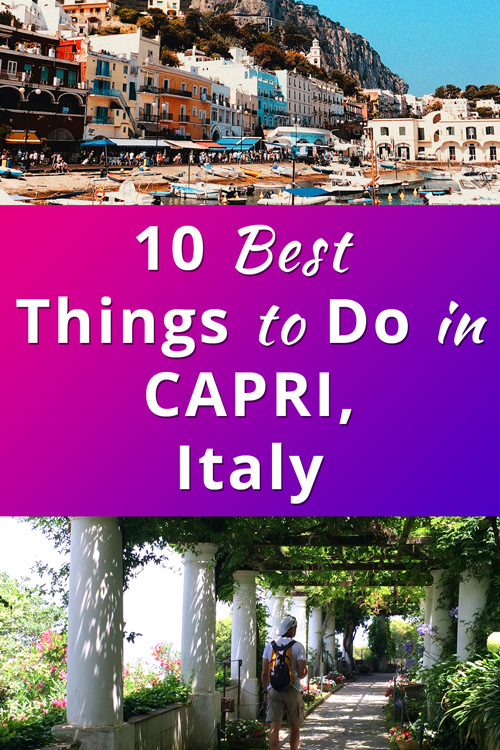
Capri is a small island in the Bay of Naples, mixing natural beauty with history and local flavor. Its bright blue waters and limestone cliffs have been wowing visitors since Roman times.
Emperors actually built villas here. Later on, writers and artists found inspiration in the island’s gardens and sea caves.
These days, people come for boat rides, the quiet lanes of Anacapri, and the lively cafés crowding the Piazzetta. Capri’s food scene leans into lemons, seafood, and simple Mediterranean recipes. Nothing too fussy, just good flavors…
You’ll find different hotels and inns, from elegant resorts with sweeping terraces to cozy family-run places tucked away on village streets. Exploring Capri means drifting from calm viewpoints to bustling squares.
Every stop adds a new layer to the island’s story. Here are 10 experiences that really bring out Capri’s colorful character, from glowing caves to those amazing sunset cliffs… just a taste of why this island keeps pulling travelers back…
Don’t miss: Amalfi Coast Map + Best Towns to Visit (Printable Illustrations)
Keep in mind: Our articles may contain errors, despite our best efforts. So, do thorough research before deciding on a travel destination.
1. The Blue Grotto (Grotta Azzurra)

This video will be loaded from YouTube.com, a third party. If you click "Play", you accept their terms of service, and their use of cookies.
The Blue Grotto is Capri’s famous sea cave with bright, glowing water created by sunlight entering through an underwater opening. Small rowboats take visitors inside when seas are calm, and the cave’s narrow entrance makes the water look silvery at first and then deep blue once inside.
The grotto has been known since Roman times, and stories say Emperor Tiberius may have visited caves on Capri during his years here. In the 19th century, foreign travelers helped make the grotto popular again, and artists loved painting its light.
The cave often closes when waves get rough, so boat tours usually check conditions each morning. Nearby, Anacapri has easy places for lunch and a quiet feel compared to Capri town.
Good stays in the area include Hotel Caesar Augustus for wide views, Capri Palace for design and art, and Hotel San Michele for classic charm. These hotels sit on the Anacapri side of the island.
Many boat tours also leave from Marina Grande and loop past the grotto as part of a full circumnavigation of the island.
Read also: 22 Best Things to See & Do in Naples, Italy: Ideas You Can’t Miss
2. Boat Tour Around the Island

This video will be loaded from YouTube.com, a third party. If you click "Play", you accept their terms of service, and their use of cookies.
A boat tour around Capri gives a simple way to see the island’s cliffs, caves, and rock formations from the water. Boats circle past the Faraglioni sea stacks, the Green Grotto, small coves, and fishing spots, and often point out historic watchtowers and old limestone quarries.
Some tours include short swimming stops when the captain says the water is safe. The Faraglioni have local names: Stella near the shore, Mezzo with a natural arch, and Scopolo farther out. People sometimes watch for the famous blue lizards said to live on Scopolo.
Many tours start at Marina Grande, the island’s main port since ancient times, where cargo once arrived from Naples. Travelers tend to choose small shared boats or private boats depending on time and budget.
Near Marina Grande, Hotel Relais Maresca offers rooms close to the docks, and funicular access to Capri town sits nearby.
In Capri town, Grand Hotel Quisisana is a classic stay with easy access to cafes and shops, while La Minerva and Hotel Flora offer boutique atmospheres not far from paths down toward Marina Piccola.
Read next: 10 Best Things To See & Do in Sicily, Italy: Don’t Miss These!
3. Riding the Chairlift to Monte Solaro
Monte Solaro is the highest point on Capri, and a simple chairlift from Anacapri glides up in about 12 minutes. The summit has wide views over the Bay of Naples and the Amalfi Coast on clear days, and you can see paths leading down to forts and old lookout points along the shoreline.
The chairlift usually starts near Piazza Vittoria in Anacapri, where people pick up quick snacks or espresso. There is also a hiking trail to the top for visitors who prefer walking downhill after riding up.
History on the mountain includes old military posts guarding the approaches to the island, plus shepherd paths used before modern roads connected Anacapri more easily.
The climate feels breezy at the summit, so a light layer often helps. Anacapri hotels near the lift include Capri Palace with a spa and art displays, Hotel San Michele overlooking the sea, and Hotel Caesar Augustus with terraces facing Vesuvius.
The area around Piazza Vittoria has small inns and cafés, making it a relaxed base for visiting Monte Solaro without crowds.
You’ll also love: 15 Best Beaches in Sardinia, Italy, for Your Summer Holidays

(Banchinella Porto, 80076, Capri, Naples, Italy – Photo by Ian Badenhorst)
4. The Gardens of Augustus and Via Krupp
The Gardens of Augustus sit on a terrace above the sea and look out toward the Faraglioni and Marina Piccola. Flower beds and curved paths frame views of cliffs and boats below. Next to the gardens, Via Krupp is a stone path that zigzags down the cliff.
It was commissioned by Friedrich Alfred Krupp in the early 1900s and became an iconic route connecting the upper town to the beach area. The path sometimes closes for safety due to rockfall risk, but even from above it shows a graceful S-shaped design.
The gardens also stand near historic spots like the Charterhouse of St. Giacomo, a 14th-century monastery with a small museum.
Visitors often stop for photos and then continue to cafés in Capri town. Good nearby stays include Grand Hotel Quisisana just a short walk away, La Scalinatella along a quiet lane, and Hotel Flora for a boutique option close to shopping streets.
From these hotels, the gardens are an easy visit, and Marina Piccola below has beach clubs and views toward the Faraglioni.
Read next: 10 Best Things to See & Do in Puglia (Italy): Bucket List Ideas
5. Anacapri’s Historic Center and Villa San Michele

(The garden of Villa San Michele, Anacapri, Naples, Italy – Photo by Mats Hagwall)
Anacapri’s center feels calm and walkable, with white-washed lanes, artisan workshops, and small piazzas. Villa San Michele, created by Swedish doctor and writer Axel Munthe in the early 20th century, stands near the top of the village.
The villa blends Classical pieces, Mediterranean gardens, and views across the bay, reflecting Munthe’s love for nature and history. Anacapri also has the Church of San Michele with a beautiful majolica floor showing the Garden of Eden.
The village once sat apart from Capri town due to steep cliffs between them, and older paths and steps were the main link before modern roads. People stop for sandals, ceramics, and lemon treats on quiet streets without much traffic.
Nearby hotels include Capri Palace with curated art and a rooftop lounge, Caesar Augustus known for its terraces and herb gardens, and Hotel San Michele for traditional style.
These stays give quick access to the chairlift for Monte Solaro and bus routes to the Blue Grotto, so days in Anacapri tend to feel easy and local.
Don’t miss: 10 Things to Buy in Italy: Ideas for Your Next Trip
6. The Faraglioni Rocks
The Faraglioni are three limestone stacks rising off Capri’s coast, shaped by waves and wind over time. Locals call them Stella, Mezzo, and Scopolo, and boat captains often point out the arch in Mezzo.
The rocks host birdlife and rare plants, and people sometimes talk about blue lizards found on Scopolo, adapted to the sun and rock. Views of the Faraglioni come from boats, the Gardens of Augustus, and terraces around Marina Piccola.
Old stories say that sailors used these rocks to navigate, and painters favored this coastline in the 19th century. The surrounding waters feel clear in summer, and swimming areas sit along Marina Piccola’s shoreline with beach clubs and simple cafés.
Good hotels with Faraglioni views include La Scalinatella in a quiet lane above the coast, Hotel Weber Ambassador near Marina Piccola, and Hotel Punta Tragara on a cliff path.
Many visitors enjoy an aperitivo facing the rocks near sunset, when light softens and boats drift across the surface.
7. Discovering Roman Villas: Villa Jovis and Villa Lysis
Villa Jovis sits on the eastern side of Capri and was once the main residence of Emperor Tiberius in the early 1st century.
The site shows remains of cisterns, rooms, and viewpoints over the sea, giving a sense of how the imperial court lived away from Rome.
Villa Lysis, built much later in the early 1900s by Count Fersen, blends Neoclassical style with Art Nouveau details and looks over quiet gardens. The walk to Villa Jovis takes time on uphill lanes, and the path passes small lemon groves and old stone walls.
Legends around Tiberius tell stories about strict rules and private life on Capri, though historians often debate what is true. Villa Lysis offers a peaceful atmosphere with literary history and a terrace over the water.
Nearby lodging in Capri town makes access easier: Grand Hotel Quisisana near the Piazzetta, La Minerva for a boutique stay, and Hotel Flora close to shopping streets. These hotels give a convenient base for morning visits before midday warmth sets in.
8. Relaxing at the Piazzetta (Piazza Umberto I)
The Piazzetta is Capri town’s small central square, officially called Piazza Umberto I. It has a clock tower, cafés with outdoor tables, and narrow lanes leading to shops. People come for coffee, pastries, and aperitivo, and there is easy people-watching at almost any hour.
The square played a role in local life for centuries, and the clock tower is a familiar landmark seen in old photos and films. Side streets hold bakeries and gelato spots, and the funicular from Marina Grande ends nearby, giving quick access from the port.
History lovers might enjoy the nearby Charterhouse of St. Giacomo, which adds quiet and art to an otherwise lively area.
Good hotels close to the Piazzetta include Grand Hotel Quisisana, which anchors the heart of town, La Minerva tucked in a peaceful lane, and Hotel Flora within a short walk.
These stays make mornings simple: a cappuccino in the square, slow shopping, and easy bus links to Anacapri or Marina Piccola.
9. Watching the Sunset at Punta Carena Lighthouse
Punta Carena lighthouse sits on the western tip of Capri near Anacapri and looks out over the sea and cliffs. The lighthouse began operating in the 19th century and still guides ships along this part of the coast.
Rocks and platforms below the lighthouse offer places to swim when seas are calm, and locals visit the area for relaxed afternoons.
Lido del Faro nearby runs a beach club with ladders into the water and simple bites. The cliffs show layers of limestone, and you might notice old coastal trails used by watchers and fishermen.
Sunset brings warm light across the cliff faces, and the sky often shifts slowly through orange and pink.
Anacapri has close stays for easy transport: Capri Palace up in town, Caesar Augustus along scenic terraces, and smaller inns dotted near bus stops.
The bus from Anacapri usually heads toward the lighthouse area, and the ride feels short. People often combine a swim and a sunset drink for a mellow end to the day.
10. Local Flavors and Food Traditions
Capri’s food leans toward fresh, simple flavors with seafood, lemons, and island-grown herbs. Torta caprese, a chocolate and almond cake, is a local favorite and likely dates to the early 20th century.
Chefs say a baker forgot flour and found the nut texture worked well. Limoncello uses lemon peels, alcohol, sugar, and water, and the island’s lemons give a bright taste. Pasta dishes often feature fresh tomatoes, clams, or squid, and many menus carry grilled fish with olive oil and parsley.
Capri’s cafés serve iced espresso drinks in summer and pastries like sfogliatelle. Food traditions connect to farming on the terraces and fishing around the island, with ingredients arriving daily from nearby coasts.
For a stay that pairs well with eating and wandering, Capri town has Grand Hotel Quisisana, La Minerva, and Hotel Flora near restaurants and shops.
In Anacapri, Capri Palace and Caesar Augustus sit close to bakeries and gelato. Even simple trattorias often offer lemon desserts that match Capri’s sunny vibe.
Read next: Top 10 Must-Try Foods in Italy for a True Taste of La Dolce Vita