
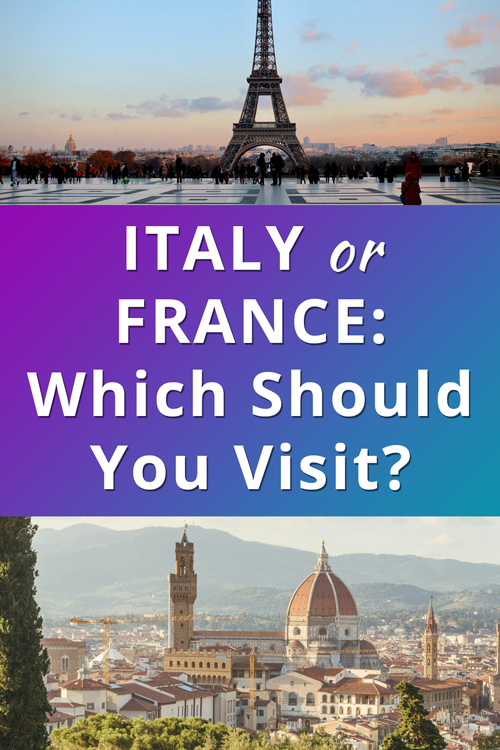
Planning a trip to Europe? It often comes down to one big choice: Italy or France.
Both countries offer incredible experiences, from world-famous cities to amazing food and beautiful scenery.
If you love beaches and warm weather, Italy is your best choice in my opinion. But. If you want diverse regions with different cultures, France could be perfect for you.
Each country has its own special charm that draws millions of visitors every year.
France gives you the romance of Paris, the wine regions of Bordeaux, and the sunny beaches of the French Riviera.
Italy offers the history of Rome, the canals of Venice, and the stunning coastlines of the Italian Riviera.
It’s really a tough call! But let’s take a more detailed look!
Read also: Looking for Authentic Italy? Start with These 25 Enchanting Small Towns & Villages
Keep in mind: Our articles may contain errors, despite our best efforts. So, do thorough research before deciding on a travel destination.
1. France vs Italy: An Overview
France and Italy each offer distinct travel experiences that set them apart from other European destinations like Spain, Portugal, or Scotland.
France excels in regional diversity and cultural variations. Italy provides better coastal experiences and often more affordable travel costs. That’s not something to ignore.
Here Are the Main Differences
France delivers exceptional regional diversity. Each region has its own culture, cuisine, and traditions.

This video will be loaded from YouTube.com, a third party. If you click "Play", you accept their terms of service, and their use of cookies.
Alsace feels distinctly different from Provence, while Normandy offers experiences unlike Burgundy. It’s almost like visiting several countries in one.
The country’s wine regions in Bordeaux and Burgundy provide world-class tastings. France’s cafe culture, especially in Paris, creates unique social experiences.
Italy focuses more on coastal beauty and ancient history. The country offers warmer Mediterranean waters and better beaches than most of France.
Italian cities like Rome, Florence, and Venice pack incredible art and architecture into compact areas. Italy costs less than France for accommodation and dining, making extended stays easier on your wallet.
Both countries provide rich museum experiences and historical sites. France, though, gives you more variety in landscapes and cultural vibes as you move from region to region.
Must read: 10 Best Towns in the South of France: Charming Destinations for Your Next Trip
Geography
France spans diverse landscapes from Mediterranean coastlines to Alpine peaks. The French Riviera provides excellent beaches, while the French Alps offer world-class hiking and skiing.
Mont Saint-Michel in Normandy creates one of Europe’s most striking tidal island experiences. The country’s canal system allows unique boat travel through different regions.
Italy has the dramatic Dolomites mountain range and beautiful northern lakes like Como and Garda. The country includes hundreds of islands, with Sicily and Sardinia offering distinct experiences.

This video will be loaded from YouTube.com, a third party. If you click "Play", you accept their terms of service, and their use of cookies.
Cinque Terre provides postcard-perfect coastal villages that attract millions annually. Italy’s boot shape creates varied climates from Alpine chill in the north to Mediterranean warmth in the south.
You’ll also love: Autumn in Provence (France): 12 Breathtaking Places You Should Visit
Accessibility
France connects easily to the rest of Europe through high-speed rail networks. The TGV system links major cities efficiently.
Direct flights serve Paris from most international destinations. Ferry connections reach England and other European countries.
France borders eight countries, making it an excellent base for exploring Spain, Italy, or other European destinations.
Italy offers good rail connections within the country and to neighboring European nations.
Rome and Milan serve as major international flight hubs. Ferry services connect to Sicily, Sardinia, and other Mediterranean destinations.
Both countries provide extensive public transportation within cities.
But. France has better infrastructure for reaching remote regions. Italy’s transportation works well for city-to-city travel but can be challenging in rural mountain areas.
Budget airlines serve both countries from across Europe, making visits from other places pretty feasible.
2. Iconic Cities and Destinations
Both offer world-famous capitals and artistic treasures, and some of Europe’s most celebrated cities and monuments.
Paris vs. Rome: The Essential Capitals

(Eiffel Tower, Paris, France – Photo by Fabien Maurin)
Paris stands as France’s cultural heart with iconic landmarks at every turn. The Eiffel Tower dominates the skyline while the Louvre houses the world’s most famous art collection.
You can spend days exploring Paris museums. The Palace of Versailles sits just outside the city with its grand halls and gardens.
Read also: Autumn in Paris (France): 10 Best Things to Do & Places to See
Rome offers ancient history you can actually touch and see. The Colosseum lets you walk where gladiators once fought.
The Roman Forum shows daily life from 2,000 years ago. Vatican City, within Rome, holds priceless art and religious treasures.
St. Peter’s Basilica and the Sistine Chapel attract visitors from around the world.
Read also: 10 Best Things to Do in Rome (Italy) in Winter & during the Christmas Holidays
Both offer distinct experiences: Paris art museums and elegant architecture, Rome ancient history through preserved ruins and monuments.
Artistic Hubs: Florence, Milan, and Lyon

(Giardino Bardini, Florence, Italy – Photo by Giuseppe Mondì)
Florence serves as Italy’s Renaissance capital. You’ll find Michelangelo’s David at the Accademia Gallery.
The Uffizi Gallery displays works by Leonardo da Vinci and Botticelli. The city’s historic center feels like an outdoor museum.
Ponte Vecchio bridge and the Florence Cathedral showcase medieval and Renaissance architecture.
Don’t miss: 10 Best Things to See & Do in Florence in Summer
Milan represents modern Italy with high fashion and business.
La Scala opera house hosts world-class performances. The Gothic cathedral in the city center impresses with its detailed spires.
Read next: 15 Best Things To Do in Milan in Summer
Lyon in France combines Roman history with French cuisine. The old town features Renaissance buildings and hidden passageways. Food lovers call it France’s culinary capital.
Charming Cities & Towns Across Both Countries
Venice floats on canals with no cars in sight. Gondola rides and St. Mark’s Square create romantic memories. The city’s carnival season brings colorful masks and celebrations.
Nice on the French Riviera offers Mediterranean beaches. The Promenade des Anglais stretches along the blue coastline. Old town markets sell fresh flowers and local foods.
Annecy in the French Alps earns the nickname “Venice of France.” Crystal-clear canals go through the medieval town. Lake Annecy provides swimming and mountain views.
Bordeaux represents French wine culture. Historic buildings line the Garonne River. Wine tours take you through famous vineyard regions.
These smaller destinations provide authentic local experiences. They offer slower-paced travel away from major tourist crowds!
Must-See Attractions and Monuments
Italy’s ancient sites offer centuries of history. Pompeii preserves Roman daily life frozen in volcanic ash. The ruins show homes, shops, and public baths from 79 AD.
France’s Normandy beaches commemorate WWII history. The region also features the medieval Mont-Saint-Michel abbey.
Religious architecture impresses in both countries. Notre-Dame in Paris represents Gothic design. The Vatican showcases Renaissance and Baroque art.
Castle and palace visits reveal royal history: French châteaux in the Loire Valley display Renaissance elegance, while Italian palaces in Florence show Medici family wealth.
These are places that shaped European culture and history.
Read also: 15 Must-See Castles in Northern Italy: High-Res Photos & Interesting Facts
3. Culture, Art, and History
Heritage and History
France offers centuries of royal history through its palaces and monuments. The Palace of Versailles showcases French royal luxury with its ornate halls and gardens.
Paris alone contains countless historic sites, from Notre-Dame Cathedral to the Arc de Triomphe.
Italy presents you with layers of history dating back thousands of years.
Rome serves as an open museum where you can walk through the Colosseum and Roman Forum. These ancient structures let you experience where gladiators fought and emperors ruled.
Florence stands as the birthplace of the Renaissance. You can explore the same streets where Michelangelo and Leonardo da Vinci once worked.
The city’s historic center remains largely unchanged from medieval times.
Art and Museums: World-Class Collections
The Louvre in Paris holds the world’s largest art collection. You can see the Mona Lisa, Venus de Milo, and thousands of other masterpieces under one roof. The museum contains over 35,000 works of art.
Italy’s Uffizi Gallery in Florence houses Renaissance treasures. You’ll find works by Botticelli, Michelangelo, and Raphael. Michelangelo’s statue of David stands in Florence’s Accademia Gallery as one of art’s most famous sculptures.
France’s artistic legacy extends beyond Paris. You can visit the Musée d’Orsay for Impressionist paintings by Monet and Renoir. Regional museums throughout France showcase local artistic traditions.
Vatican City in Rome contains the Sistine Chapel with Michelangelo’s ceiling frescoes.
Italian churches serve as galleries filled with priceless religious art. Every major Italian city offers world-class museums and galleries.
Traditions and Local Customs
France celebrates its culture through regional festivals and culinary traditions. You can experience wine harvest festivals in Bordeaux or lavender festivals in Provence. French café culture remains central to daily life.
Italy’s festivals connect deeply to religious and historical traditions.
Venice Carnival transforms the city into a masked celebration each February. You can witness medieval festivals in Siena or religious processions throughout the country.
Both countries maintain strong family traditions around food and celebration. Meals are social events that can last for hours.
Local markets offer regional specialties and traditional crafts. French and Italian customs vary significantly by region.
You can experience different dialects, foods, and traditions as you travel through each country. That’s part of the adventure!
Read also: Easter in Italy: 7 Must-Visit Destinations
4. Culinary Experiences
Both offer world-class food scenes. France excels in wine production and refined cooking techniques. Italy shines with fresh ingredients and diverse pasta traditions.
Signature Dishes and Local Specialties
French cuisine centers on technique and rich flavors. You can enjoy coq au vin in Burgundy, made with local red wine and tender chicken.
Provence offers bouillabaisse, a seafood stew with saffron and herbs. Lyon is France’s food capital. The city serves traditional bouchon dishes like quenelles and saucisson.
You’ll find escargot, French onion soup, and duck confit throughout the country.
Italian food varies greatly by region. Northern Italy specializes in risotto, polenta, and cream-based sauces.
You can taste authentic carbonara in Rome or fresh pesto in Liguria. Southern Italy focuses on tomatoes, olive oil, and seafood.
Sicily offers arancini and caponata. Tuscany provides hearty ribollita soup and bistecca alla fiorentina.
Each Italian region protects its food traditions. You’ll discover different pasta shapes, cheese varieties, and cooking methods as you travel.
Wine Regions: Bordeaux, Loire Valley, Tuscany, and Beyond
France produces some of the world’s finest wines. Bordeaux is known for bold red blends made with Cabernet Sauvignon and Merlot.
The Loire Valley is all about crisp Sancerre and sweet Chenin Blanc.
Burgundy specializes in Pinot Noir and Chardonnay. Champagne is the only region allowed to call its sparkling wine “champagne,” and they stick to traditional methods.
Tuscany dominates Italian wine production. Chianti Classico uses Sangiovese grapes grown in specific zones.
Don’t miss: 30+ Tuscan Countryside Aesthetic Landscapes for Inspiration
You can visit historic wineries and taste Brunello di Montalcino. Piedmont produces Barolo and Barbaresco wines.
Sicily makes both red and white varieties with native grapes. There’s a lot of variety if you’re into exploring.
| Region | Famous Wines | Grape Varieties |
|---|---|---|
| Bordeaux | Cabernet blends | Cabernet Sauvignon, Merlot |
| Tuscany | Chianti, Brunello | Sangiovese |
| Loire Valley | Sancerre, Muscadet | Sauvignon Blanc, Chenin Blanc |
Dining Culture and Food Markets
French dining follows set meal times. Lunch is between 12-2 PM, dinner after 7:30 PM.
You’ll get multiple courses with wine at restaurants. French food markets run on certain days: Lyon’s Les Halles de Lyon is a favorite for gourmet products.
Provence markets sell fresh herbs, olives, and local produce.
Italian meal culture is more about family and social time. Aperitivo starts around 6 PM with snacks and drinks. Dinner kicks off late, sometimes after 8 PM.
Italian markets are open most days in most cities. Rome’s Campo de’ Fiori has fresh ingredients every morning.
You can shop for vegetables, meats, and regional specialties.
Both countries close restaurants between lunch and dinner, so plan your meals, or you might find doors shut.
Sweets and Treats: Gelato and French Pastries
French pastries have centuries of tradition. Croissants, pain au chocolat, and macarons are everywhere, especially in Paris.
French desserts include crème brûlée, tarte tatin, and profiteroles. Every region has its own specialty, like canelés in Bordeaux or calissons in Provence.
Gelato differs from ice cream: less air, warmer temperature, and usually more flavor. Italian gelaterias make fresh flavors daily with what’s in season. You’ll find pistachio, stracciatella, and limoncello.
Italian desserts change by region: Sicily has cannoli and cassata; Tuscany brings out ricciarelli cookies and panforte cake.
Gelato is usually cheaper than French pastries. You can get a couple scoops for the price of one fancy French dessert.
5. Natural Landscapes and Relaxation
France and Italy both show off some pretty wild natural beauty. France has the glitzy Riviera and the lavender fields of Provence.
Italy? Think Amalfi Coast cliffs and the rolling green hills of Tuscany.
Beaches and Coastlines: French Riviera, Amalfi Coast, and Cinque Terre
The French Riviera is on France’s Mediterranean coast. Towns like Cannes and Nice have pebble beaches, luxury resorts, and those clear blue waters you see in postcards.
Italy’s Amalfi Coast is all about dramatic cliffs and winding roads. Towns like Positano and Amalfi look like they’re glued to the hillsides.
Cinque Terre has five old fishing villages connected by hiking trails. The views over the Ligurian Sea are unreal.
France’s Normandy coast is totally different: think white cliffs and the famous D-Day beaches. There’s history and scenery all in one spot.
Scenic Countryside: Provence, Tuscany, and Beyond
Provence in southern France is famous for purple lavender fields from June to August. You can drive through endless rows, visit farms, and just breathe in the scent.
The area also has olive groves, vineyards, and hilltop villages. Markets in places like Aix-en-Provence sell honey, herbs, and handmade soaps.
Tuscany is all rolling hills, cypress trees, and stone farmhouses. The Val d’Orcia region is especially photogenic, changing colors with the seasons.
You can visit wineries, stay at farm estates, and check out small towns like Montalcino and Pienza. The countryside is perfect for slowing down and just enjoying it all.
Islands and Lakes: Sicily, Annecy, and More
Sicily has beaches, mountains, and even an active volcano. Mount Etna offers hiking or skiing, depending on when you go. The island’s coastline mixes rocky coves with sandy beaches.
Lake Annecy in the French Alps is known for its clear water and views of snowy peaks. You can swim, kayak, or bike around Annecy.
Italy’s Lake Como and Lake Garda have similar vibes: historic villas, pretty towns, and calm water for relaxing.
Outdoor Adventures
The Alps stretch across both countries. In winter, skiing is huge: Chamonix in France, Cortina d’Ampezzo in Italy.
In summer, you’ve got hiking, biking, and rock climbing. Cable cars make it easy to get up high for those amazing views.
Rural areas offer farm stays and retreats. You can join a wine harvest, take a cooking class, or head out on a nature walk to get a feel for the local landscape.
Read also: 20 Stunning Italian Mountain Villages and Small Towns You Have to Visit
6. Practical Considerations
France usually costs more for hotels and meals. Italy often gives you better value, especially outside the big cities.
Cost
Italy is generally easier on the wallet. Budget trips can run $60-80 a day, while mid-range is more like $120-150.
Meals are $15-25 per person. Budget hotels start at $40-60 a night, and train tickets between cities are $25-50.
France comes with a higher price tag, especially in Paris. Budget travel is $80-100 a day; mid-range is $150-200.
Meals cost $20-35. Budget hotels start at $60-80. Trains between cities are $30-70.
Both countries have free museum days and city tourist cards for discounts. Shopping at local markets and picking lunch menus can help you save.
Best Time to Visit
Spring (April-May) brings mild weather and fewer crowds. Hotel prices are reasonable, and places aren’t packed.
Summer (June-August) is the peak: crowds everywhere, prices up, and temps in the 80s or even 90s. Book early and expect lines.
Fall (September-October) is ideal for weather and harvest festivals. Prices drop a bit after the summer rush.
Winter (November-March) has the lowest prices, but some coastal spots shut down. Christmas markets make up for it, though.
France’s shoulder seasons are best for the weather. Italy’s southern regions stay warm even in winter, so you can visit year-round.
Travel Itineraries for Different Interests
Art and Culture Lovers should set aside 7-10 days at least. Italy: Rome (3 days), Florence (2), Venice (2). France: Paris (4), Lyon (2), Avignon (2).
Food Enthusiasts might want 10-14 days to really dig in. Try Tuscany, Emilia-Romagna, and Sicily in Italy. In France, focus on Provence, Burgundy, and Lyon.
Beach Seekers should check out Italy’s Amalfi Coast or Cinque Terre. France has the Riviera and Corsica. Five to seven days is a good start for coastal trips.
First-time visitors can see highlights in a week or so per country. Mix big cities with at least one rural region for the best experience.
Cultural Etiquette and Tips
In Italy, if you’re visiting churches, it’s best to dress modestly. Shorts are a no-go at most religious sites.
Cappuccino? That’s really just for breakfast, not after lunch. Tipping around 10% is common, but no one’s going to chase you down if you don’t.
Dinner doesn’t really get going until after 7:30 PM. Shops tend to shut down for a long lunch break, usually from 1 to 4 PM.
It helps to know a few Italian greetings: you’ll get more smiles that way.
Don’t miss: 9 Mistakes to Avoid in Italy for a Stress-Free Adventure
In France, always open with a “Bonjour” when you walk into a shop. People really notice if you skip it.
Dress a bit sharper if you’re eating out, especially in nicer places. Upscale areas frown on casual clothes.
Service charges are baked into your bill, but leaving a small tip is still seen as a nice gesture. Lunch is usually from noon to 2 PM, and don’t be shocked if a lot of places are closed on Sundays.
Trying out a few French phrases goes a long way. Locals appreciate the effort, even if your accent’s terrible.
7. So, Which Destination Should You Visit?
Well, after this long comparison, I think you now have (almost) all the information you need to make your decision. So I’ll leave it to you: where will you go, in France or Italy? Let me know in the comments below.